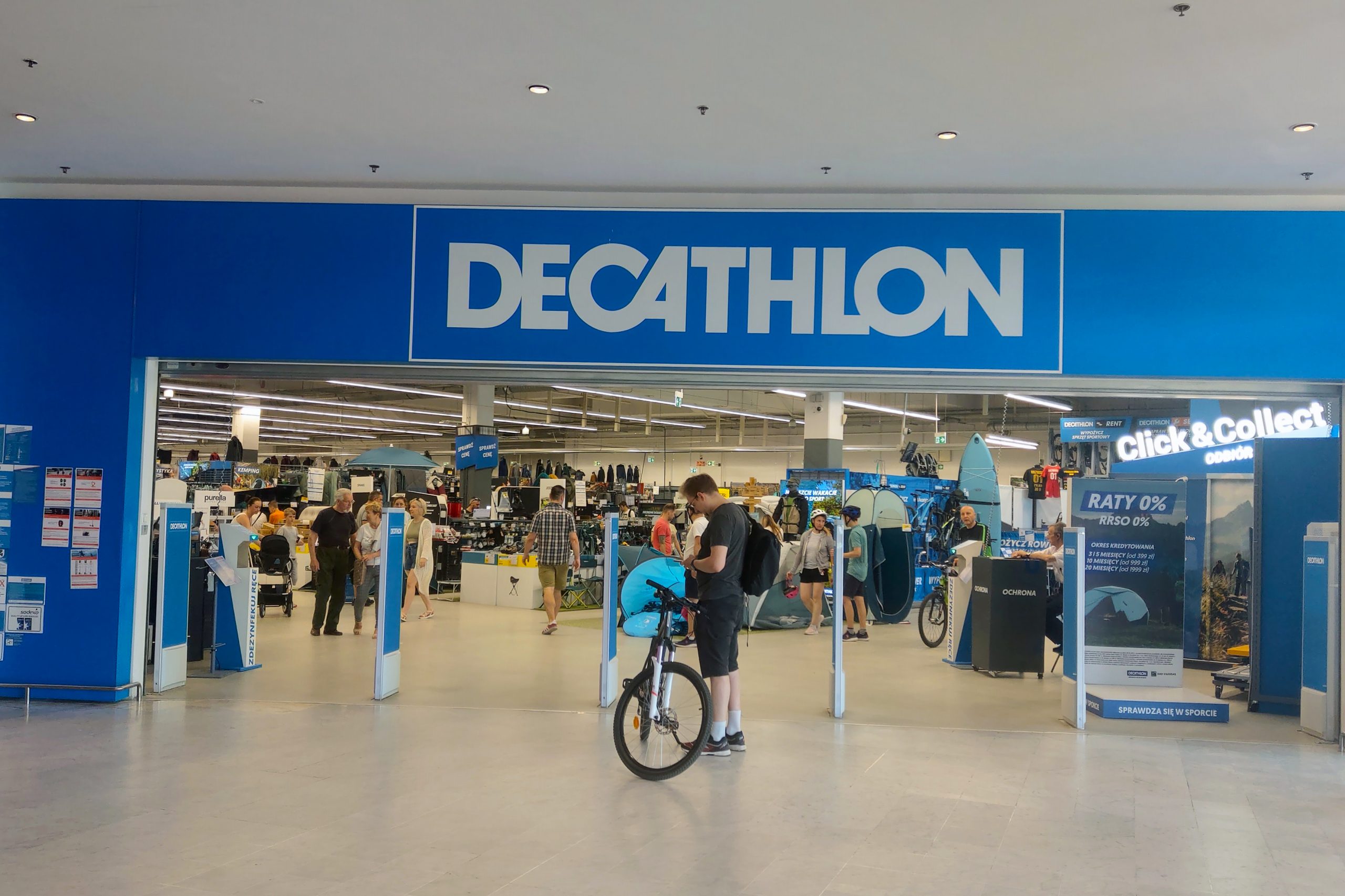
Hello, hello, my friends and readers of the e-Plus Agency blog! Today is the day for another post in the series about VTEX's great success stories , which I started in January 2023. For those who don't remember, I began with the Carrefour article . Then, in February and March, I presented the Aramis and Ri Happy cases, respectively . And now it's Decathlon's turn, which invested in unified commerce with VTEX technologies and thus increased revenue across its sales channels. Read on!
GET TO KNOW DECATHLON
Decathlon is the world's largest retailer of sports apparel, goods and accessories. It has more than 1.700 stores in more than 60 countries, which employ a battalion of more than 108 thousand people. But it was not always so.
Founded in 1976 by Michel Leclercq, Decathlon had humble beginnings in a building on the premises of Auchan, in a shopping center in Englos, France. The company, however, grew quickly and its stores spread across Europe, America, Asia, Africa and Oceania.
In Brazil since 2001, Decathlon maintains a bike assembly line and textile products production in this country. In addition, it has had a virtual store since 2013, a marketplace, 45 physical stores and a distribution center. In Brazil alone, it has more than 2 employees.
In 2017, this giant sporting goods retailer migrated its online store to VTEX. This gave the company a flexible architecture with an integrated OMS, a front-end independent of the back-end, and customizable capabilities. This improved the flow between e-commerce and physical stores and prepared the brand for the omnichannel project that would be implemented in 2021.
THE DECATHLON VTEX PROJECT
After consolidating its e-commerce platform with VTEX, Decathlon's directors envisioned a future with unified commerce . That is, the idea was to integrate physical and online sales channels to offer consumers seamless shopping experiences.
Thus, using various VTEX technologies, the sporting goods retailer placed its physical stores at the heart of the strategy, but without leaving aside e-commerce. In other words, the stores became fundamental to the brand's digital strategy.
SOLUTIONS
After four years of evolution in e-commerce using the VTEX platform, Decathlon's management came to the conclusion that it was time to take the next step, that is, it was time to unify the sales channels. In this way, from 2021, the company started to invest in several VTEX omnichannel technologies, such as:
1 – VTEX inStore
Decathlon implemented VTEX inStore , an app integrated with the VTEX OMS order management system . Together, these two technologies allow for the integration of inventory from physical and online stores, thus facilitating commerce across both channels.
Available on smartphones and tablets, VTEX inStore allows the seller to access the history of the integrated purchase journey of each consumer. Thus, he can view the products that the consumer abandoned in the e-commerce and try to complete the purchase in the store. Furthermore, with the mobility of the VTEX inStore Decathlon can now expand its sales to sporting events and sporting venues.
2 – Infinite shelf
Through VTEX inStore, Decathlon can implement what we call the infinite shelf. The infinite shelf occurs when a consumer cannot find a particular product in one store, but the salesperson can access the inventory of another store or the e-commerce platform and thus complete the order. This omnichannel strategy certainly generates significantly more sales.
3 – Fulfillment
The VTEX inStore app features a fulfillment module that allows order picking, preparation, and invoicing operations to take place within the physical store. In other words, a single solution makes it possible to generate orders and enable the entire fulfillment process.
4 – Marketplace in with VTEX inStore
VTEX's native marketplace solution allows Decathlon to have an in-store marketplace , enabling other companies (sellers) to sell their products on the sporting goods retailer's website. Now, the brand intends to add the products of these seller companies to VTEX inStore, thus increasing product availability for consumers in its stores.
5 – Dark stores
Decathlon began using dark stores integrated with VTEX OMS, which enabled omnichannel experiences such as ship-to-store. Within the scope of ship-to-store, it is possible to send products from one dark store to another to serve local consumers, thereby improving the shopping experience and facilitating sales.
RESULTS OF THE DECATHLON VTEX PROJECT
The Decathlon VTEX omnichannel project yielded good results for the sporting goods retailer. For example, digital sales within physical stores started to generate up to 5% of revenue share. In addition, customers changed their shopping patterns, so that 30% of purchases with VTEX inStore participation had Express Pickup. Express Pickup is when the customer is in a physical store and the seller identifies that the product is in another store. Then, the customer closes the order and goes to the other store to pick up the product at the same time.
Finally, with the VTEX inStore fulfillment module, the company was able to prepare around 80% of the app's orders using stock from physical stores. This proves that the retailer's consumers today have high stock availability.
HOW TO DEPLOY A PROJECT WITH VTEX?
To implement a project using VTEX technologies, such as Decathlon's, you should seek support from VTEX partner agencies. The e-Plus Agency , for example, has been a VTEX partner since 2015 and has already produced online stores for Speedo, Pirelli, and Pierre Cardin, among hundreds of other brands, in more than ten countries in the Americas and Europe, including Brazil, Portugal, Chile, Costa Rica, Argentina, and Spain.
It's worth remembering that e-Plus Agency is globally recognized by the VTEX Quadrant as an agency with a high capacity for executing e-commerce projects and advanced technical knowledge. To hire e-Plus Agency for your project using VTEX technologies, click the button below and start a conversation with our team via messaging app: