order tracking
The agent checks the order status directly with the WHO and responds in natural language, without relying on a fixed flow of questions.

The VTEX CX Platform connects AI agents to the catalog, OMS, checkout, promotions, and service channels to execute sales and post-sales journeys. e-Plus plans, implements, integrates, and evolves this architecture for your specific scenario — from pre-configured agents to customized flows in Agent Builder.
Results reported by VTEX in different operations. They vary according to the use case and the scenario of each company.
 CX Platform
The VTEX CX Platform is VTEX's native AI agent architecture, with direct access to catalogs, OMS, SmartCheckout, and promotions within the platform itself. This allows the agent not only to respond but to execute real actions in the operation—checking an order, processing an exchange, closing a sale.
e-Plus, a VTEX partner since 2015, is responsible for configuring, integrating, and evolving these agents according to the journey, catalog, and business rules of each operation.
The agent checks the order status directly with the WHO and responds in natural language, without relying on a fixed flow of questions.
Conversational campaigns re-engage those who abandoned their shopping cart, re-establishing the context of the purchase within the channel where the customer is currently located.
The agent manages the exchange process from the initial order to confirmation, following the business rules configured for the operation.
Cancellations that comply with the defined rules are resolved by the agent without opening a support ticket, reducing customer wait time.
Recommendations based on the catalog and actual inventory of the operation — the agent indicates what exists and what is currently available.
PIX, credit and debit processed within the conversation itself — the agent handles the payment, not just provides a link.
Each agent on the CX Platform operates within one of these four roles, which organize their performance throughout the customer journey — from initial contact to after-sales.
Pre-purchase contextualization: the agent understands the customer's history and current situation before taking action.
Agent-led sale: checkout via WhatsApp, with PIX, credit and debit card payments, without leaving the conversation.
Self-service: tracking, exchanges, returns, and cancellations resolved without human intervention.
Re-engagement: conversational campaigns that recover abandoned shopping carts and reactivate inactive customers.
CX Platform is prepared to operate natively across multiple channels. e-Plus configures which agents, journeys, and integrations make sense for each channel within your operation—it's not an automatic replication of the same agent across all of them.
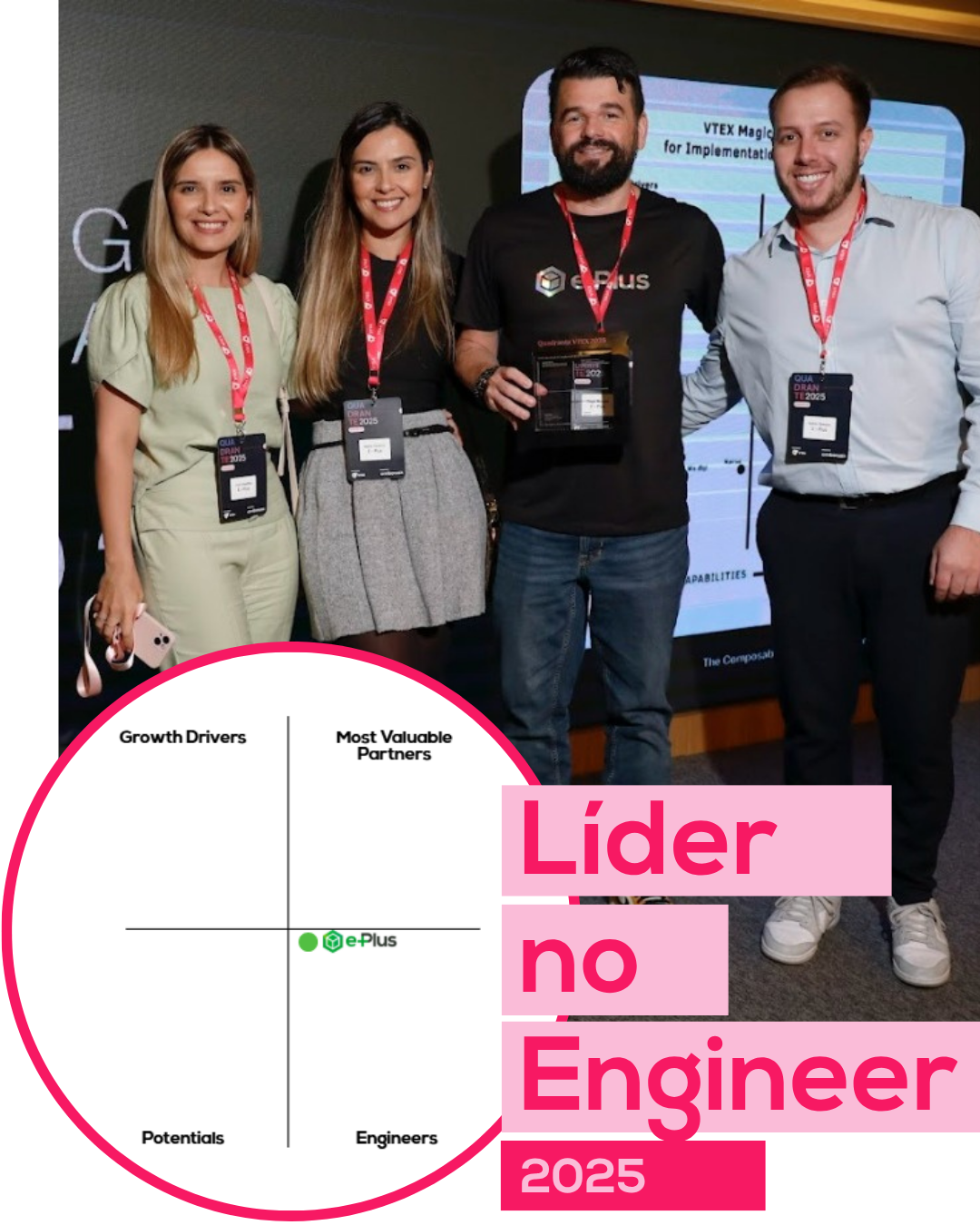
The VTEX Quadrant annually recognizes the best-performing implementation partners in the ecosystem. e-Plus is present in the Quadrant and has been a certified VTEX partner since 2015 — more than 10 years dedicated to commerce projects on the platform.
This journey includes the deployment of complete stores, complex catalog, OMS, and checkout integrations, and, most recently, the configuration of AI agents for sales and customer service with the VTEX CX Platform.
Learn about e-Plus's experience with VTEX.


Over 10 years of continuous partnership with VTEX (since 2015)
The same agent architecture supports operations ranging from those starting with pre-configured agents to B2B operations with complex business flows and multiple integrations. e-Plus assesses the scenario and recommends the appropriate implementation path.
Tracking, cart recovery, exchanges, and checkout via WhatsApp are all configured using your existing catalog, OMS, and checkout system in VTEX.
Custom agents tailored to specific business flows, with deep integrations to CRM, ERP, and BI tools, designed for highly complex operations.
Two implementation paths, a single agent architecture behind it: the VTEX CX Platform.
Activating the first agents is the beginning of the journey. New journeys, new channels, conversion adjustments, and Agent Builder evolution happen after go-live, with continuous monitoring. This is the role of CS Flex — e-Plus's continuous management model for VTEX operations.
Learn more about CS Flex →The implementation of the VTEX CX Platform follows e-Plus's own methodology, built from real-world commerce projects on VTEX — not just the official product documentation.
Mapping the sales and customer service journeys with the highest volume and greatest potential impact, based on real operational data.
Defining which agents to activate first, considering implementation effort, data maturity, and expected return.
Defining integrations, business rules, permissions, and operational limits for each agent within the operation.
Configuration of predefined agents or construction via Agent Builder, with integration to catalog, OMS, checkout and other operational systems.
Validation of workflows in a controlled environment, fine-tuning of conversations, and deployment to production with technical support.
Performance monitoring, new use cases, and expansion to other channels, supported by CS Flex after go-live.
Many chatbots lose customers precisely when they need help the most: during the handoff to a human agent. At CX Platform, Live Desk was designed to reduce this friction.
The agent receives the conversation history and order data already compiled, which avoids asking the customer to repeat what has already been said to the AI agent.
Many AI tools communicate well, but rely on parallel integrations to function. The VTEX CX Platform, implemented by e-Plus, operates within the VTEX stack — and it is this proximity to the catalog, OMS, and checkout that supports real-world execution.
The agent accesses real order, customer, and catalog data at the time of the conversation, instead of working only with generic responses.
Tracking, exchanges, cancellations, and checkout are handled by the agent directly within the conversation, not just indicated by a link.
The implementation takes into account existing integrations in your VTEX operation — CRM, ERP, marketplaces — so that the agent operates with the correct data.
Business rules, permissions, and operational limits for each agent are defined during implementation and reviewed as the operation evolves.
It's VTEX's own AI agent architecture, with native access to the catalog, OMS, and SmartCheckout. The agents operate within the commerce stack, with the ability to execute actions—not just suggest—according to the configuration made during implementation.
A traditional chatbot typically limits itself to responding and directing the customer to another channel to complete the action. CX Platform agents have direct access to the catalog, OMS, and checkout, allowing them to perform the action—check an order, process an exchange, close a sale—within the conversation itself.
Among the most common cases are order tracking, shopping cart recovery, exchanges and returns, cancellations, product concierge services, and conversational checkout. The right combination depends on the journeys prioritized in the diagnosis of your operation.
CX Platform is prepared to operate on channels such as WhatsApp, webchat, voice, email, SMS, and social media. e-Plus works with you to define which channels make sense to activate each agent on and with what configuration.
It varies depending on the activation method. Pre-configured agents on an existing VTEX operation tend to be faster to put into production; customized agents via Agent Builder, with integrations to CRM, ERP or BI, require their own schedule, defined in the diagnosis.
This is VTEX's tool for building custom agents with specific business flows and rules. e-Plus uses Agent Builder to design bespoke agents when pre-configured agents don't cover the complexity of the operation.
Yes, within Mode 02 — Advanced Customization. e-Plus evaluates the existing integrations in your operation and designs the necessary workflows for the agent to operate with the correct data from CRM, ERP, or BI tools.
When the agent identifies the need for escalation, the conversation is transferred to a human agent with the order history and data already gathered, reducing the need for the customer to repeat information already provided to the agent.
e-Plus conducts journey diagnostics, prioritizes use cases, defines agent architecture and governance, configures and integrates the solution into your VTEX operation, performs tests, and monitors the go-live — in addition to continuous evolution after activation, via CS Flex.
The VTEX CX Platform billing model is defined by VTEX itself and may vary depending on usage and contract. e-Plus presents the current conditions during the diagnostic phase, along with an estimate of the scope of your implementation project.
No. Despite the name, the VTEX CX Platform does not work exclusively with the VTEX e-commerce platform. It can be integrated with other external platforms and systems through APIs and customized flows, as well as connecting channels such as WhatsApp, Instagram, webchat, and email.
The depth of integration and available features may vary depending on the platform used, its APIs, and the needs of each operation.
Schedule a Strategic Diagnosis with an e-Plus specialist. We will evaluate your VTEX operation and indicate the most suitable implementation path for your scenario — Accelerated Activation or Agent Builder.
Fill out the form and an e-Plus specialist will contact you to introduce you to the right agents for your situation.
Receive contact from one of our specialists by filling out the form below or via WhatsApp Tel: +55 11 98863-7077