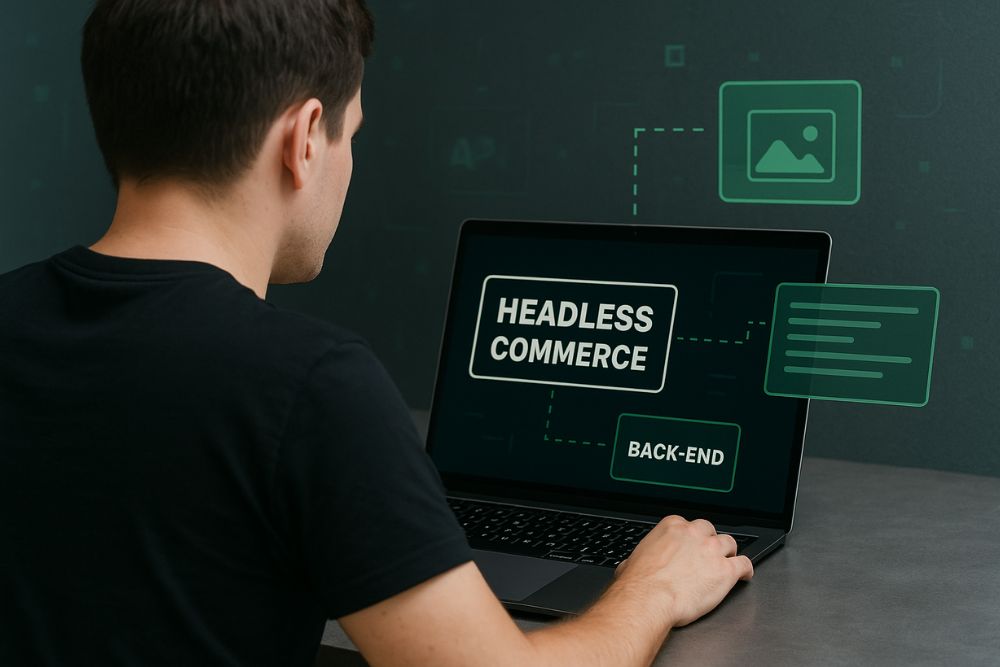
The term " Headless Commerce " is everywhere, often presented as the ultimate solution for flexibility and performance in e-commerce. But amidst all the enthusiasm, the question that really matters to your operation arises: Is Headless Commerce right for me? The answer, however, is not a simple "yes" or "no." The decision to adopt a headless architecture is strategic and depends directly on the maturity, resources, and, above all, the objectives of your business.
Instead of simply using it, it's crucial to conduct an honest analysis. After all, this approach, which separates the "head" (the frontend , or the storefront the customer sees) from the "body" (the backend , where product, order, and customer management reside), offers incredible benefits, but also brings new challenges and costs. Therefore, this article will serve as a guide to help you evaluate the pros and cons, ensuring you make the right choice for the future of your online store.
SCENARIOS WHERE HEADLESS COMMERCE MAKES SENSE (THE PROS)
Headless architecture is n't a universal solution, but it shines brightly in specific scenarios. If you identify with one or more of the points below , you're likely a strong candidate to benefit from this approach.
- Your brand demands a unique experience: If traditional themes limit your creativity and you want to create a fully personalized and immersive shopping journey, headless is the way. It, in fact, allows designers and developers to create any interface they can imagine, without the constraints of a ready-made template.
- Speed is your obsession (and it should be): In a competitive market, milliseconds matter. Headless frontends are built with modern technologies (fframeworks like React, Vue or Svelte) that result in extremely fast websites and applications. This directly impacts your Core Web Vitals, improves SEO and, consequently, increases conversion rates.
- Your strategy is truly omnichannel: Do you plan to sell not only on a website, but also through a native mobile app, in-store kiosks, smart TVs, or even virtual reality devices? Headless allows a single backend feed all these “heads” or points of contact in a cohesive way.
- Agility for the marketing team is crucial: With decoupled architecture, your marketing team can, for example, create new landing pages or change the frontend content independently, without needing the help of developers backend for every small change. This speeds up campaigns and A / B tests.
THE CHALLENGES AND COSTS TO CONSIDER (THE CONS)
On the other hand, the freedom and performance of headless flying come at a price. It's crucial to be realistic and understand the responsibilities this choice entails for your operation.
- Technical complexity and development cost: this is not a solution “plug-and-play“The implementation of the Headless requires one andqualified development team and experienced in APIs e frontend frameworks. Consequently, the initial cost of building a custom “head” from scratch is significantly higher than configuring a ready-made theme.
- Ongoing maintenance costs: by adopting headless, you become the owner of your frontend code. This means your team will be responsible for updates, bug fixes, and security for this layer, representing an ongoing cost that doesn't exist with traditional platforms.
- Possible loss of native functionality: many e-commerce platforms, such as VTEX or Shopify, offer a rich ecosystem of apps and a visual theme editor. When opting for headless, some of these tools, which depend directly on the native theme, may not work. In other words, features like previewing changes or apps that modify the storefront may require custom integrations.
SO, WHAT IS THE ANSWER TO “IS HEADLESS COMMERCE FOR ME?”
To simplify your decision, see this direct comparison:
| Feature | Traditional e-commerce (Monolithic) | Headless Commerce (Decoupled) |
| Design Flexibility | High, but limited to theme structures | Total. Unlimited creative freedom |
| Speed (Performance) | Good, but can be optimized | Exceptional, optimized for Core Web Vitals |
| Initial cost | low to moderate | High. Requires custom development |
| Technical Complexity | Low. Ideal for beginners and SMEs | High. Requires a team of developers. |
| Maintenance | Simplified, managed by the platform | Retailer's responsibility (frontend) |
CONCLUSION: A STRATEGIC DECISION, NOT JUST A TECHNICAL ONE
Returning to the central question: “Is Headless Commerce for me?” The answer depends on an honest balance between your ambitions and your capabilities. If your company is in a phase of accelerated scaling, has a robust technology team (or the budget to hire one), and sees a unique customer experience as your main competitive differentiator, then headless is undoubtedly a powerful path to consider.
On the other hand, for most small and medium-sized businesses, or those just starting out, the traditional approach still offers an unbeatable combination of cost-effectiveness, speed of implementation, and ease of use. It allows you to focus on what matters most in the beginning: selling and growing.
The choice, therefore, is not about which technology is "better," but about which one is most suitable for your current situation and your future goals.
Still unsure which path to take? Explore more content on the e-Plus blog , learn about some of our headless commerce case studies , and deepen your knowledge to make the best decision!