The modern consumer no longer differentiates between the physical store shelf and the virtual shopping cart . Today, customers research on their cell phones while walking through the mall and prefer to pick up their order at the nearest storefront. Given this hybrid behavior, questioning whether the omnichannel experience still makes sense in 2026 is to ignore the irreversible evolution of the market . Instead of acting as a mere competitive differentiator, this technological integration has become the only viable way to reduce the Cost of Acquisition per Channel (CAC per channel).
Consequently, brands that insist on operating with isolated inventories suffer from high stockout rates and lose commercial traction . Therefore, unifying the user journey is the ultimate strategy to ensure logistical efficiency and profitability of your sales ecosystem.
WHAT YOU NEED TO KNOW ABOUT THE OMNICHANNEL EXPERIENCE
- What is it: The omnichannel experience is the complete synchronization between a brand's physical and digital sales channels, offering a unique, seamless, and frictionless shopping journey.
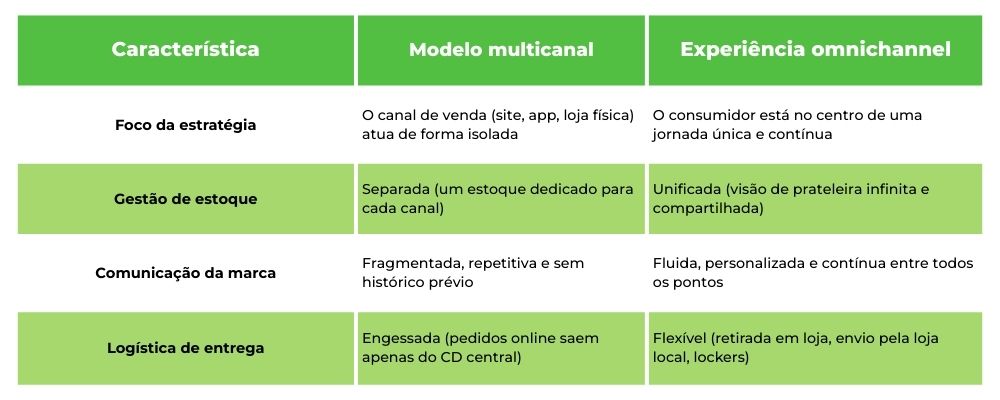
- Infinite shelf: The model unifies corporate inventories. In this way, e-commerce can sell products that are physically located on the shelves of physical stores;
- Logistical agility: The strategy enables modern and fast delivery methods, such as... BOPIS (Buy Online, Pick Up In-Store) And Ship from Store (direct shipping from the physical store);
- Unified data view: The system centralizes the consumer's history, connecting browsing behavior on the website with purchase history at the Point of Sale (POS);
- Global scale: Operations with integrated channels facilitate business scalability into new markets, standardizing the quality of service and logistics across different countries.
The End of Fragmentation and the Reduction of Logistics Costs
In our experience implementing unified architectures at e-Plus , we've observed that a lack of communication between channels destroys profit margins . Often, a product sells out in the e-commerce distribution center but gets stuck in the physical store's inventory. When a brand adopts a robust omnichannel experience through advanced platforms like VTEX or Shopify Plus , this financial bottleneck disappears instantly . The physical inventory transforms into a mini distribution center. Furthermore, according to recent research from the NRF ( National Retail Federation ), retailers with strong channel integration manage to retain up to 89% of their active customer base.
A common challenge in digital expansion projects is scaling the brand without losing operational consistency or frustrating the customer . To illustrate the effectiveness of this strategy, we highlight the case of the women's fashion brand Lofty Style . The company not only restructured its digital ecosystem in Brazil with an absolute focus on the omnichannel model, but also used this technological base to begin its expansion into Portugal and Spain. Check out the details of this major internationalization project guided by e-Plus in this video:
Multichannel Model vs. Omnichannel Experience
The direct impact on purchase satisfaction metrics.
The transition to an integrated model positively impacts the company's operational indicators. Firstly, offering free in-store pickup attracts qualified digital traffic directly to the physical environment . As a result, physical salespeople gain the opportunity to make additional sales ( cross-selling ), increasing the average transaction value. Therefore, the physical store ceases to be a real estate liability and becomes an active hub for acquisition and relationship building.
Furthermore, the fluidity of this process dramatically increases the brand's Net Promoter Score (NPS) . The customer feels recognized by the company, regardless of where they choose to use their credit card or request an exchange. Therefore, friction decreases and brand trust soars. Companies that offer online purchase returns directly at the physical store checkout, for example, drastically reduce the frustration of reverse logistics.
The Technological Consolidation of Retail
In short, the invisible separation between physical and digital commerce has ceased to exist in the buyer's mind . Therefore, brands must reflect this reality in their operations. Maintaining disconnected ERP systems and e-commerce platforms in 2026 is the fastest path to losing relevance . On the other hand, companies that invest in data unification reap immediate results in efficiency and gain commercial traction to dominate new territories.
Therefore, we invite you to explore other e-Plus blog content to continue refining your business strategy. Now, if your project requires immediate traction and safe expansion, talk to our team of experts . Discover the best omnichannel e-commerce deployment solutions to scale your business ecosystem, uniting the physical and digital worlds with high-performance technology.
FAQ – Frequently Asked Questions about the Omnichannel Experience
What is an omnichannel experience?
Omnichannel experience is a corporate strategy that fully integrates physical and digital sales channels. It allows consumers to research, buy, receive, and exchange products using multiple brand touchpoints simultaneously and seamlessly.
What are the advantages of omnichannel for physical stores?
The main advantage is transforming the physical store into an advanced logistics hub. This speeds up deliveries in the region, attracts customers from the website to the physical store (generating extra sales), and eliminates losses from idle inventory.
How does technology enable omnichannel commerce?
Technology enables the model through headless e-commerce platforms and integrated management systems. These tools synchronize customer data, pricing rules, and inventory in real time, ensuring absolute accuracy on the website, in the app, and at the store checkout.