
Inbound Marketing, also called Inbound Marketing, is a marketing concept based on content publishing. Thus, when applied to e-commerce, an Inbound Marketing project basically aims to attract, convert, relate and delight consumers through the use of content.
The content I am referring to can be, for example, articles for blogs, e-books, posts for social networks and E-mail Marketing messages. Infographics, webinars, and videos, plus lists, tutorials, podcasts, and product descriptions from an online store's sales pages.
In an Inbound project, this type of content serves both to attract and educate consumers. It allows you to turn unknown visitors into leads, that is, into contacts. Soon after, in a second phase, the content makes it possible to educate contacts until they feel able to make their first purchase and subsequent purchases.
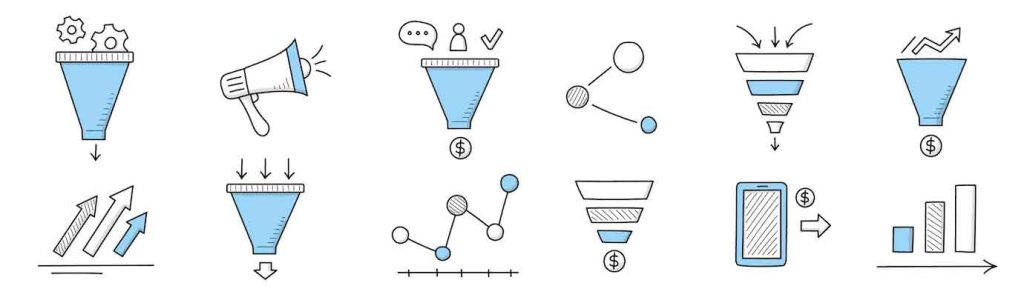
In this process, which occurs within the Sales Funnel , consumers go through 7 levels of evolution. They evolve from unknown visitors to leads and then to suspects, prospects, customers, loyal customers, and brand promoters. In an Inbound Marketing project, this evolution can be visualized in what is called the Relationship Framework.

Inbound Marketing in E-commerce
Click the button below to download the free e-book "Inbound Marketing for E-commerce" produced by Agência e-Plus!
While this evolution takes place, consumers go through the 4 stages of awareness, consideration, intent, and decision in the Customer Journey . But for this to happen, it's necessary to invest in a resource called Lead Nurturing . In short, all these and other resources should be part of a good Inbound Marketing project.
INBOUND MARKETING PROJECT FOR E-COMMERCE: HOW TO GET STARTED
As said, an Inbound Marketing project encompasses the use of content, which makes it possible to capture consumers into your Sales Funnel, and educate them with Lead Nurturing so that they can evolve in the 7 levels of the Relationship Ruler and in the 4 phases of the Consumer's Journey. This whole process takes place in 4 steps, they are:
1 - Attraction:
At this stage of your Inbound project, you must attract visitors to your Top of Sales Funnel (see graphic available in this post) using content. Publish, for example, SEO content on your blog, on your video channel and on the sales pages of your online store. This type of content will be found on search engines by internet users. Remember, at this stage, the content should show people that they have a problem that needs to be resolved. That is, he must make them aware.

2 - Conversion:
The goal now is to make visitors who have come to your blog, video channel or online store thoroughly study the problems they have and possible solutions. That is, the content should make them delve into the subject. In addition, it should guide people to register an email and thus become leads. In other words, it's time to turn unknown visitors into known contacts. In the Consumer Journey, this is the consideration phase.
3 - Relationship:
Right in the middle of the Sales Funnel, this is the stage of the Inbound project designed to educate contacts, ie suspects (cold leads) and prospects (warm leads), until they feel comfortable buying. This educational process, which we call Lead Nurturing, consists of sending personalized emails to groups of leads with the same characteristics. The idea is to make them enter the intention phase of the Consumer Journey, preparing them for the moment of purchase that will follow.
4 - Enchantment:
Once nurtured in the Relationship phase of the Inbound Marketing project, leads fall into the Bottom of the Sales Funnel. Here, your content should be as persuasive as possible, with a view to getting leads into the decision phase of the Consumer Journey. This is where leads must make the decision to make a purchase from your online store, thus becoming your customers. Later, they can also become your customers and even promoters of your e-commerce.
These, therefore, are the 4 stages of a good Inbound project. To carry them out, you will need a number of software tools such as email marketing platforms, analytics tools, CRM systems, CMS systems, SEO plugins, and marketing automation platforms like RD Station.
Furthermore, an inbound marketing project requires a specialized team. If you don't have one, don't worry. In this case, you can always hire an inbound marketing agency like Agência e-Plus , for example, which has clients in various regions of Brazil and abroad.
ADVANTAGES OF INBOUND MARKETING
A well-executed Inbound project can provide several benefits to your e-commerce. Just to give you an idea, I selected three statistics that prove how good this strategy can be for your business. Follow:
- 47% cheaper to get a lead through Inbound Marketing than through Outbound Marketing (HubSpot cited by Digital Network);
- 92% of companies that invest in Inbound Marketing achieved a positive return (HubSpot quoted by Flammo);
- 19,7% is the annual growth in traffic from leading content companies against 2,5% growth from other companies (Aberdenn quoted by Neil Patel).
Furthermore, it's worth mentioning that, according to iMedia Connection cited by Rock Content , 60% of consumers have a more positive view of a brand after consuming its content. And Inbound Marketing, in this context, is fundamental.
As soon as you can, click on “ Inbound Marketing Examples ” and discover 4 companies that use this resource!