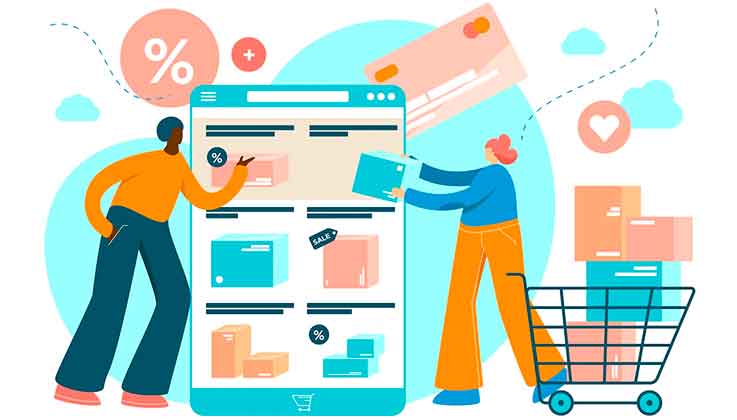
Design trends for e-commerce are nothing more than natural inclinations or dispositions for the use of certain items and design and ux design concepts in e-commerce sites such as virtual stores and marketplaces, with a view to ensuring a good shopping experience. purchase.
Namely, the design of an e-commerce site takes into account hundreds of items such as color, images, “Buy” buttons, recommendations such as “upsell” and product return policies, for example. Each store can use one or more of these items. However, when most people use a certain item, there is a design trend for e-commerce.
DESIGN TRENDS FOR E-COMMERCE: A SURVEY OF 200 SITES
To find out the main design trends for e-commerce, the North American CRO consultancy, Invesp, conducted a survey of 200 of the leading e-commerce websites today. Check out the results below:
- 71% of e-commerce sites surveyed display images in the virtual cart;
- 79% have a “Continue shopping” button on the virtual cart page;
- 57% have a clear return policy on their virtual cart page;
- 80% provide privacy guarantees on the virtual cart page;
- 54% employ virtual cart upsell and cross-sell;
- 58% offer live assistance via phone on the virtual cart page;
- 50% have carts that display promotion/coupon code boxes;
- 68% display multiple shipping options;
- 64% allow the consumer to checkout anonymously, that is, as a guest;
- 50% show estimated delivery times for different shipping options on the same page.
These items therefore represent some of the design trends for e-commerce. Let's say they passed the performance tests of most big online stores. Therefore, it is considered that they are fundamental in any online store.
THE IMPORTANCE OF TESTING DESIGN IN E-COMMERCE
Keeping up with e-commerce design trends is a great idea to improve the performance of your online store. However, you cannot fail to carry out your own tests in order to know which are the best items, functions and applications to incorporate in your store specifically.
There are many ways to test your online store's design. With heatmaps , for example, you can see which areas of your site consumers access most and which they access less. This way, you can optimize the less popular areas to improve usability.
Another way to test the design is through A/B testing , which allows you to compare two versions of the same layout element to discover which one generates the best performance. This test can be used to compare buttons, content, promotions, and other factors.
To test your online store and go beyond e-commerce design trends, use software such as Hotjar and Google Optimize , for example, which have heatmap tools and A/B testing, among other very useful features for this purpose.
SUPPORT FOR E-COMMERCE TEST, DESIGN AND REDESIGN
For a number of reasons, it is not always possible for online retailers like you to apply design trends to e-commerce or test layout improvements on their own. So, whether to test or create a store design or redesign, you can enlist the help of an e-commerce agency.
e-Plus Agency , for example, is an e-commerce agency based in São Paulo with operations throughout Brazil and in countries in the Americas and Europe such as Argentina, Spain, and Portugal. Specializing in VTEX , e-Plus Agency has already produced more than 300 online stores for medium to large-sized companies.
With services such as e-commerce implementation , design , redesign , support and evolution of e-commerce , as well as CRO and Digital Marketing consulting , among others, Agência e-Plus can help you boost the sales performance of your e-commerce business.
To get in touch with the e-Plus Agency team and learn more about it, just click on the next button and start a conversation via the messenger app: