
Have you ever had the feeling that your marketing campaigns are "flying blind"? The ROI in the Meta Ads dashboard doesn't match that of Google Analytics , and the actual number of sales on the e-commerce platform differs from both. If this sounds familiar, you're not alone. With stricter privacy policies and the imminent end of third-party cookies , the traditional way of collecting data is collapsing. It is in this critical scenario that server-side tracking becomes a vital necessity for survival.
Therefore, in this article, we will demystify this technology. You will understand how it solves data loss caused by blockers and restrictive browsers , ensuring that you continue to make decisions based on real numbers, not flawed estimates. So, get ready to regain control of your digital operations.
What is happening with the current data?
To understand the solution, we need to diagnose the problem. Historically, web data measurement has always relied on client-side tracking . In this model, the user's browser (Chrome, Safari, Firefox) is responsible for loading third-party scripts and pixels ( such as the Facebook Pixel or the Google Ads tag ) to record a conversion.
However, this model is broken. Modern browsers, led by Safari (with ITP – Intelligent Tracking Prevention ) and now Chrome, are aggressively blocking third-party cookies.
The result? A significant portion of your sales and leads simply don't appear in media reports . In other words, if the browser blocks the script, for the advertising platform, that sale never happened. This destroys the algorithm's intelligence, increases traffic costs, and makes campaign optimization more difficult.
Client-side vs. Server-side
In the world of technology and marketing, it's essential to understand the distinction between these two frequently used terms in English:
Client-side tracking : This is the traditional method. It occurs on the user's device ("client"), where the browser loads the scripts. It is easy to install but vulnerable to ad blockers, user connection failures, and browser privacy restrictions.
Server-side tracking : This is the evolution. That is, instead of the browser sending the data to Meta or Google, it sends it to your server (a secure intermediary) . It is your server that processes and sends the information to the advertising platforms . The user does not "see" this process, and ad blockers cannot easily prevent it.
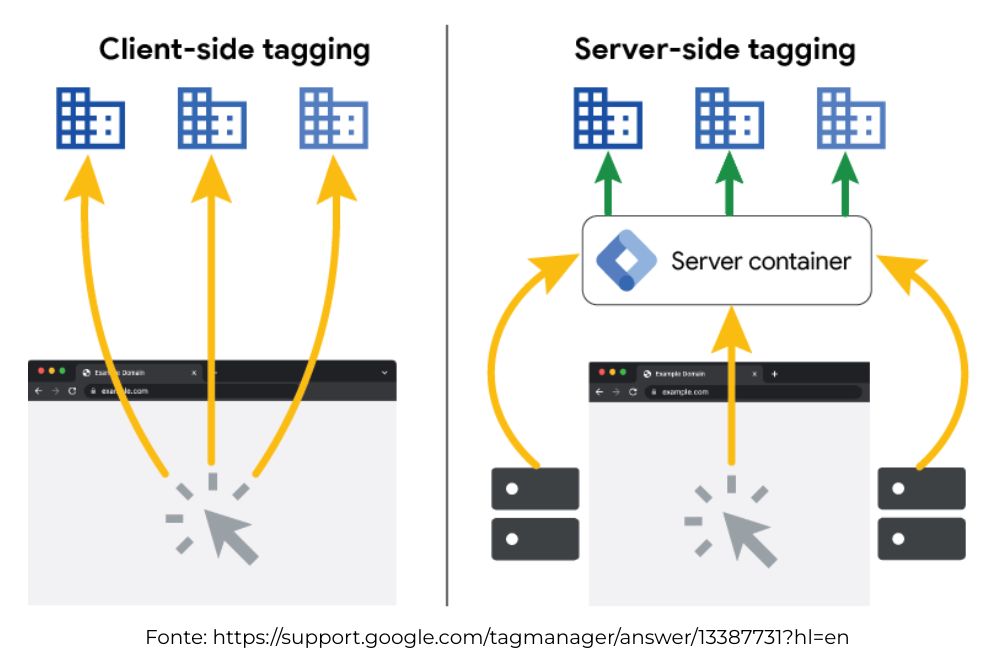
HOW SERVER-SIDE TRACKING SOLVES THE PROBLEM
The great "magic" of server-side tracking lies in the shift of control . Therefore, by moving data collection to the company's server, you create a controlled environment , beyond the reach of restrictions imposed by browsers or extensions installed by users.
See how this transforms your operation:
- Protection against AdBlockers: Since communication occurs between servers (from your website to the Meta/Facebook API, for example), browser extensions cannot intercept or block the sending of the conversion event.
- Data quality and accuracy: The server centralizes processing. This eliminates discrepancies caused by user internet outages at the exact moment the pixel loads. More accurate data means smarter media algorithms.
- Privacy and security (LGPD): The data is processed in a secure environment before being shared. This allows you to filter what will be sent to third parties, ensuring greater compliance with the LGPD (Brazilian General Data Protection Law) and the GDPR (General Data Protection Regulation), thus conveying greater consumer confidence.
SITE PERFORMANCE
Furthermore, there is a technical benefit that pleases both users and Google: the loading speed.
For example, in the old model ( Client-side ), the user's browser needed to load dozens of heavy scripts (Analytics, Hotjar, Facebook, Google Ads, TikTok, etc.). This made the site slow and navigation laggy.
On the other hand, with server-side tracking , this load is transferred to the cloud . The browser loads fewer scripts, resulting in faster pages and a smoother browsing experience . And, as we know, speed is a direct ranking factor in SEO and conversion in e-commerce.
A CASE AS AN EXAMPLE
To illustrate the real impact of this technology, let's analyze a scenario ( based on real market challenges ) of a company in the electronics segment.
This store was facing a serious problem: the Google Ads dashboard was reporting 20% fewer sales than the store's internal system (ERP). Upon auditing the traffic, the team noticed that a large portion of the audience was accessing the site via iOS devices (iPhones), which have very strong built-in privacy protections.
The solution adopted: the company decided to implement server-side tracking using Google Tag Manager (GTM) Server-Side in conjunction with the Facebook Conversions API (CAPI) and GA4 Server-Side.
The results obtained:
- Data recovery: The gap between the ad panel and the store's database has decreased from 20% to less than 5%. In other words, sales that were previously invisible are now appearing in the reports.
- CPA reduction: With the ad platform algorithms receiving more real conversion data, it was able to optimize ad delivery. In this way, the Cost per Acquisition (CPA) It decreased by 15% after two months of machine learning with better data.
- User Experience: The checkout page load speed has improved significantly, as the heavy tracking scripts have been moved to the server.
While this is an illustrative example, it accurately reflects the movement that major players are making . For instance, Google itself launched " Google Tag Manager Server-Side " to facilitate this migration, and Shopify is gradually migrating to server-side solutions to offer better security and compliance.
Is the implementation complex?
Many managers fear the technical complexity, and it's fair to say that the barrier to entry is higher than with the old method. Although the initial setup requires technical infrastructure knowledge (dealing with cloud containers, such as Google Cloud Platform or AWS), the market has evolved to simplify this.
Server-side tracking represents the next generation of data collection and measurement . It's not a temporary "workaround," but a new internet architecture.
However, it is vital to have a specialized partner, as incorrect implementation can lead to serious problems, such as:
- Data duplication: If you don't configure "deduplication" correctly, you could end up counting the same sale twice (once by the browser and once by the server), falsely inflating your results.
- Server costs: Unlike the old method that used user processing (free for you), the server-side method uses your cloud processing, which can generate monthly costs that need to be scaled.
THE FUTURE OF DATA MEASUREMENT
Server -side tracking is the ultimate answer for a world where privacy is a priority. As data protection laws become more stringent and browsers tighten their grip on cookies even further, relying solely on the user's browser to measure your business success becomes an extremely high-risk strategy.
Companies adopting this technology today aren't just "fixing a technical problem"; they're building a competitive advantage . They'll have richer data, faster websites, and greater legal security than their competitors who remain stuck in the old model.
CONCLUSION
The era of " easy, cheap, and unrestricted " data collection is over. However, this does not mean the end of performance marketing or data intelligence. On the contrary, we are entering a more mature, professional, and user-respectful phase.
Server -side tracking is the technological bridge that allows your e-commerce business to cross this valley of uncertainty brought about by the end of cookies. It restores visibility to your sales, protects your customer's privacy, and ensures that every penny invested in media is correctly accounted for. Ignoring this change is like accepting to navigate with an incomplete map.
Adopting this technology is a necessary step for companies that want to thrive in the new world of data privacy.
Is your e-commerce business truly ready for the post-cookie era, or are you still losing unseen sales? Don't leave your operations in the dark. Talk to the experts at e-Plus today and implement the data infrastructure that guarantees performance and security for your business.
Frequently Asked Questions about Server-Side Tracking
What is server-side tracking and how does it differ from the traditional method?
Server-side tracking processes and sends user behavior data from your website's server (or a container in the cloud), rather than directly from the user's browser (client-side). This ensures greater accuracy and security, as it does not rely on cookies that can be blocked by browsers or extensions.
Does server-side tracking help with LGPD compliance?
Yes. Because the data passes through your server before being sent to third parties (such as Facebook, Google, or TikTok), you have complete control over what information is shared. This makes it easier to filter sensitive data and ensures that processing complies with privacy regulations such as the LGPD and GDPR, increasing consumer confidence.
Does this technology improve my website's speed?
Yes, significantly. After all, by moving heavy tracking scripts and third-party pixels from the browser to the server, you reduce the amount of code the user's device needs to process. This results in faster page loading, better Core Web Vitals scores, and smoother browsing.
Why do I need this if I already use Google Analytics?
Traditional Google Analytics (Universal or GA4 implemented only via browser) suffers from cookie blocking and restrictions from browsers like Safari and Chrome. Server-side tracking complements and protects your data collection, ensuring that the information reaching Analytics is accurate and complete, minimizing losses caused by AdBlockers.
Does server-side tracking work for Facebook Ads?
Absolutely. In fact, it's the basis of Facebook's "Conversion API" (CAPI). This technology allows you to send purchase, registration, and lead events directly from the server to Facebook, helping the ad algorithm optimize campaigns and reduce CPA, even when the user is using iOS devices with tracking blocked.