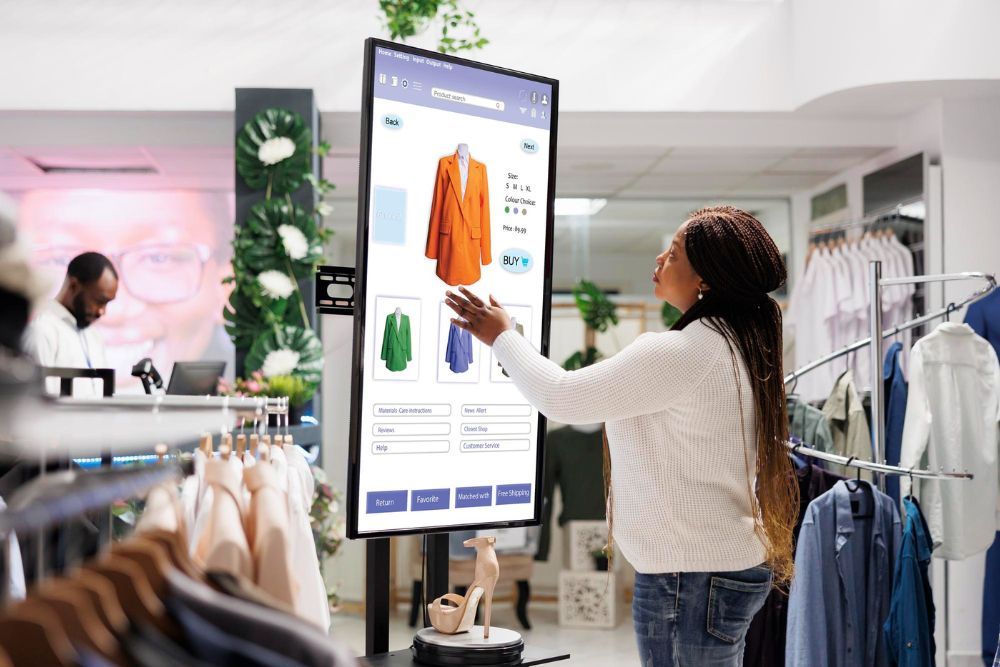
Have you ever experienced or witnessed the following scene: a customer enters a store, falls in love with a product, decides to buy it, but when it comes time to choose the size or color, receives the dreaded response from the salesperson: “ Unfortunately, we don’t have it in stock, only at the downtown branch or on the website .” The result? The customer leaves frustrated and the sale is lost, often to a competitor who is just a click away on their cell phone. However, this scenario is completely avoidable with the endless shelf strategy.
In a market where convenience reigns, limiting sales to what fits in your store's physical space is a serious strategic error . In this sense, connecting the physical world to the digital world is a survival necessity. Therefore, in this article, we will delve deep into the concept of endless aisle (the global term for this practice), show how it works technically and, most importantly, how you can use it to leverage your results, transforming stockouts into customer loyalty opportunities.
What exactly is the Infinite Shelf?
First, we need to demystify the concept. The endless shelf is a sales model within the concept of unified commerce or omnichannel . It allows the physical store to sell products that are not physically available in its local inventory, accessing the inventory of the e-commerce distribution center, other branches, or even external partners.
Basically, the dynamic works like this:
- The customer cannot find the product on the rack.
- The seller accesses a terminal (tablet, smartphone or POS) integrated into the e-commerce platform.
- He locates the product in the "virtual inventory," makes the sale right there, and collects payment at the store's checkout.
- The customer chooses whether they want to receive the product at home or pick it up at another store.
In this way, the physical store ceases to be limited by its four walls and becomes a showroom with access to the full potential of its digital catalog.
The Problem of Disruption: Alarming Data
Why is this so urgent? Because stockouts cost global retailers billions. When a consumer can't find what they want, the chances of them buying something "similar" are low. In fact, they're more likely to pull out their smartphone and search for the same item on Google. If your website isn't there, or if the seller doesn't offer an immediate solution, you've lost.
Furthermore, maintaining huge inventories in all physical stores is financially unfeasible. The cost of storage and the risk of "storage" (products that don't sell) erode profit margins. The endless shelf solves this equation by allowing you to maintain leaner inventories at the ends of the chain, centralizing the long tail in the Distribution Center (DC).
HOW IT WORKS IN PRACTICE: VTEX TECHNOLOGY
As VTEX partners for over a decade , we see this functionality operating natively. The VTEX platform , through the inStore module , facilitates this integration.
The system unifies inventory. In other words, when a salesperson consults the system, they don't just see "store A's inventory," they have a global view. Consequently, the sale is saved. According to information from VTEX itself , this integration allows not only selling your own inventory but also expanding to third-party inventories (partner sellers) , creating a true sales ecosystem.
For example, imagine an appliance store. It doesn't need to physically display all refrigerator models. It can have the best-selling models and sell niche models (exotic colors or industrial sizes) via endless shelving, using stock from the factory or a distribution partner.
ENDLESS ISLE
In the global technology and retail universe, you'll often encounter the term "endless aisle ." So, let's clarify it for you:
Endless aisle : refers to the ability of a physical store to allow customers to browse and purchase the entire range of a retailer's products, even if those items are not stocked at that specific location.
It's the opposite of a stockout . While a stockout is a failure, an endless aisle is the technological solution that makes inventory virtually unlimited for the in-store consumer.
THE 4 PILLARS OF SUCCESSFUL IMPLEMENTATION
Implementing the endless shelf isn't just about installing software. It's a change in culture and processes. If you're a manager, you need to pay attention to these four pillars:
1- Real Technological Integration
It's no use having a tablet in the salesperson's hand if the inventory isn't updated in real time. The frustration of selling something that's listed in the system but ran out in the distribution center 5 minutes ago is worse than not selling it at all. Therefore, your e-commerce platform and your ERP need to communicate in real time . VTEX's architecture is designed to support these simultaneous requests without delay.
2- The Tax and Fiscal Issue
This is the "Achilles' heel" in Brazil. Selling in the store (CNPJ A) and delivering from the distribution center (CNPJ B) requires a well-designed tax architecture for the correct issuance of the invoice . Above all, it is necessary to configure the payment and billing splitting rules to ensure tax compliance without hindering operations.
3- Logistics
The promise of the endless shelf is delivery. If the customer bought in-store to receive at home, the shipping needs to be competitive (or free, as a differentiator) and fast. The system must be able to calculate the exact shipping cost and delivery time at the moment of purchase on the seller's terminal.
4- The Human Factor: The Salesperson's Commission
Herein lies the secret to success or failure. If the salesperson feels they are "losing the sale to the website," they will boycott the tool. In other words, the commission rule must be clear: a sale made via the endless aisle is a sale from the physical store. The salesperson needs to be fully compensated for this transaction. When the team understands that the tool helps to meet the target, adoption is immediate.
CASE STUDY: THE TURNAROUND IN SPORTS RETAIL
To illustrate the real impact of this technology, let's analyze the scenario of a store in the sporting goods sales segment (based on real challenges solved by e-Plus).
The scenario: this chain had stores in shopping malls with extremely expensive and limited physical space. The operation constantly suffered from a lack of specific shoe sizes and jerseys from less popular teams. The customer would come in, ask for a jersey from team X in size XL, the local stock didn't have it, and the sale was lost.
The solution: the endless shelf strategy was implemented . Self-service kiosks and tablets were installed for salespeople to access the central inventory and that of other branches in real time.
The results:
- Sales recovery: In just 3 months, the chain identified that 15% of the total revenue from physical stores came from products that were not physically in the store at the time of purchase.
- Inventory optimization: Stores stopped stocking slow-moving items, freeing up valuable rack space to better display new releases and high-demand products.
- Customer Satisfaction: the index of NPS (Net Promoter Score) It increased significantly, as customers began leaving the store with a "guaranteed purchase," eliminating the need to look for the item at the competition.
Expanding Horizons: Partnerships and Marketplaces
The evolution of the endless aisle goes beyond your own inventory. As highlighted on the VTEX blog, it's possible to integrate partner inventories.
Imagine you sell furniture. You could stock your physical store with home decor items from a partner, selling them via tablet and earning a commission, without ever having purchased that inventory. This transforms your store into a solutions hub , increasing your product mix without impacting your cash flow with inventory purchases.
Why is VTEX a leader in this?
VTEX doesn't see online and offline as separate worlds. With VTEX inStore , the platform offers a native solution where the shopping cart is unified . The seller can identify the customer (who has already purchased from the site), see their preference history , and offer highly personalized service.
Furthermore, VTEX's composable architecture allows for the connection of different logistics and ERP systems, simplifying the fiscal complexity we mentioned earlier.
CONCLUSION
The endless aisle is undoubtedly one of the most powerful tools for modern retail . It breaks down physical barriers, optimizes working capital invested in inventory, and, above all, puts the customer at the center of the strategy.
In 2026, telling the customer " we don't have it " is a choice, not a necessity. The technology to avoid this already exists and is accessible. The competitive advantage will lie with those who can execute this integration seamlessly , training their team and ensuring that the technology works in favor of the human experience.
Is your business ready to break down the walls of the physical store and sell without limits?
e-Plus specializes in implementing complex omnichannel and endless aisle scenarios on the VTEX platform . Talk to our consultants today and let's design the unified sales architecture that will boost your store's revenue.
Frequently Asked Questions about Infinite Shelves
What is an infinite shelf?endless aisle)?
Endless shelf is a unified commerce strategy that allows physical stores to sell products that are not currently in stock. Through a digital terminal (tablet or computer), the salesperson accesses the inventory of the e-commerce site or other branches and completes the sale, offering home delivery or later pickup.
What are the benefits of endless shelving for the retailer?
The main benefits include: recovering sales that would be lost due to stockouts, increasing the average order value, the possibility of working with smaller stores and leaner inventories, and greater customer satisfaction. In addition, it allows for the collection of data on product demand at each physical location.
How does the seller's commission work on Prateleira Infinita?
For the strategy to work, the system must assign the sale from the endless shelf to the physical store salesperson. In the system (such as VTEX inStore), the salesperson logs in and the platform directly counts the sale towards their sales target, ensuring team engagement and avoiding channel conflicts.
Do I need a specific platform to have Infinite Shelf?
Yes, you need an e-commerce platform that supports the integration of multiple inventories and channels (omnichannel), such as VTEX. In addition, you need an enterprise resource planning (ERP) system capable of handling the fiscal complexities of invoicing from one location and delivering from another.