How is the consumer doing in the pandemic? In this article, I present a synthesis of research carried out by four companies on the subject. At the end, I also discuss the e-commerce billing in the second quarter of 2020. Follow along!
FOUR SURVEYS ON CONSUMER IN THE PANDEMIC
Do you want to know how consumer behavior is in the coronavirus pandemic? Well, now check out a summary of studies carried out by Accenture, Globo, Nielsen and Future Consumer Index on this topic:
Accenture study
According to data from business consultancy Accenture, consumers were divided into four distinct groups during periods of quarantine and social isolation:
- 1 Group - Looking for the “Old Normal”
These consumers, who represent 15% of the total, think that sooner or later life will return to the way it was before the Covid-19 pandemic. Therefore, they have made small changes to their habits. Many of them think isolation is overdone.
- 2 Group - In search of reinvention
About 21% of consumers are using the quarantine period to reinvent their habits. Above all, they have discovered new opportunities for digital shopping. In addition, they are investing time to take care of their health and family.
- 3 Group - living on the edge
Consumers in this group represent 29% of the total. They are very concerned about their health and also about finances, having reduced expenses more intensely. In this way, they distanced themselves from public places. They believe that social isolation is very mild.
- 4 Group - living with caution
Cautious people mainly value control and moderation. They represent a share of 35% of the total, which has avoided places like bars, events, restaurants and public transport. However, they continue to frequent places that they consider essential.
Globe polls
Globo's Research department, in partnership with its Market Intelligence department, is producing a dashboard with data on the behavior of the Brazilian population during the Covid-19 pandemic, which can be viewed on the Gente website.
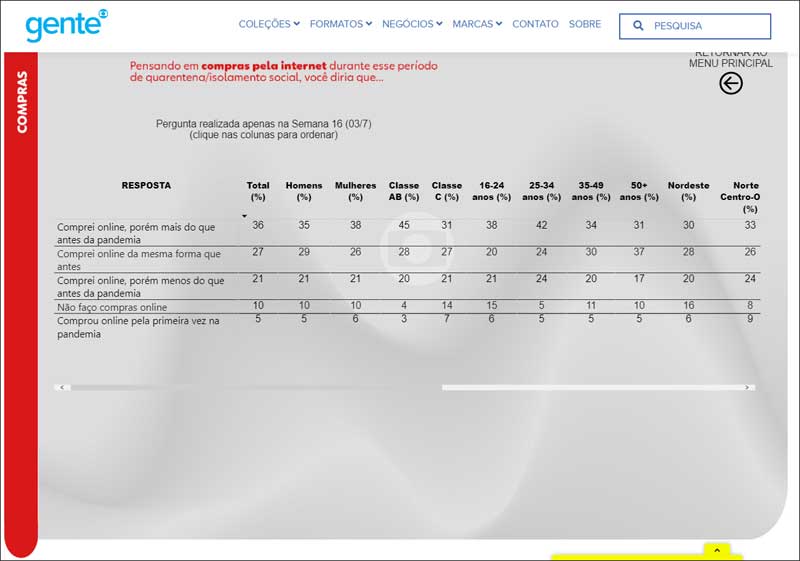
One of the polls (which was carried out on July 3, 2020) was “Thinking about internet shopping during this period of quarantine/social isolation…” followed by alternatives, to which:
- 36% of consumers indicated that they had purchased online, much more than before the pandemic;
- 27% reported that they shopped online in the same way as before;
- 21% said they shopped online, but less than before the pandemic;
- 10% said they still do not shop online;
- 5% revealed they shopped online for the first time during the pandemic.
Another poll taken on April 3, 2020, within the scope of the same study, showed that 46% of consumers intend to buy clothes and accessories soon after the pandemic passes. Another 28% think about buying shoes, 24% perfumes, 18% furniture, 17% home appliances.
Nielsen Institute study
A Nielsen study cited on the Consumidor Moderno website reveals that:
- 3,9% was the growth in pasta consumption during the pandemic;
- 76% was the increase in Extra and Pão de Açúcar customers in e-commerce;
- 31% was the increase in new customers in e-commerce.
Future Consumer Index Survey
The EY Future Consumer Index study conducted with 1.112 consumers between May and June 2020 shows that:
- 46% increased the use of digital means for payment;
- 7% maintained the use of money;
- 59% started using online banking more;
- 5% remained in physical banks.
As can be seen when we collect key data from each of these surveys, the consumer in the pandemic is predominantly cautious. He has been making more e-commerce purchases than he did before the quarantine and isolation period. Anyway, this new consumer who was born out of necessity has also used less cash and more digital resources to make payments.
E-COMMERCE BILLING
Brazilian e-commerce earned BRL 33 billion in the second quarter of 2020, which represents an increase of 104,2% over the same period of the previous year. The data were published in a report by Neotrust/Compre&Confie.
According to the same study, 83 million orders were made in the period. About 24 million people bought at least one item between April and June this year. Approximately 6 million people joined e-commerce for the first time.
Access and read our article “ 10 changes in e-commerce post-Covid-19 ” and understand how the Coronavirus crisis has led companies to seek digital transformation.