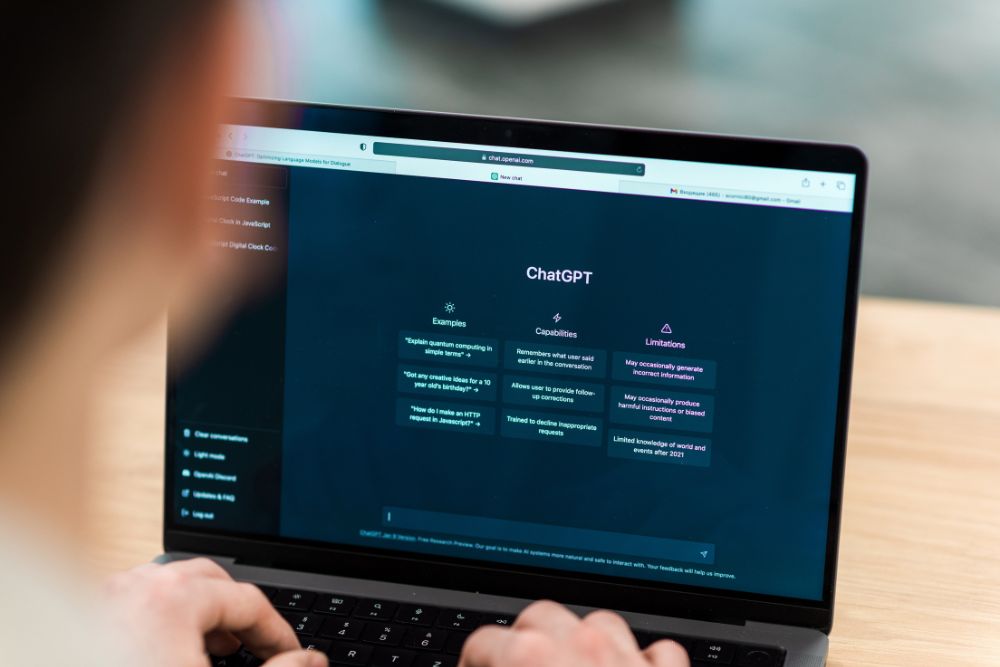
Product registration . This is probably the most time-consuming, repetitive, and honestly, least strategic task in your e-commerce operation. However, the product description is your "silent salesperson" and a fundamental pillar of your SEO . So, how do you register hundreds of new SKUs for Christmas without spending thousands of hours or generating duplicate content? This is where ChatGPT for e-commerce comes in.
But the secret isn't using the tool, it's how you use it. Unfortunately, generic prompts create generic descriptions . That's why this practical guide will give you 5 advanced prompt templates . After all, by the end of this reading, you'll know how to transform ChatGPT into a registration assistant that creates SEO-optimized and conversion-focused descriptions.
THE DANGER OF THE GENERIC PROMPT
First of all, let's understand the most common mistake. Many managers ask ChatGPT: " Write a description for a blue running shoe. "
As a result, the AI delivers robotic text, lacking personality and, worse, lacking focus on SEO or conversion . After all, ChatGPT isn't a magician, it's a co-pilot . Therefore, it needs detailed instructions (the " prompt ") to deliver a professional result. Basically, a quality prompt should include: Role (who it is), Task (what to do), Tone of Voice, and Constraints (rules).
5 Advanced Chat Prompts for E-commerce
Here are 5 prompt templates that you can copy, paste, and adapt today.
1- The “SEO Master” prompt
This is your fundamental prompt. That's because it focuses on creating a complete description, already optimized for the main keyword.
Prompt: “ Act like an expert in SEO and e-commerce copywriting. I want you to create an optimized product description for [Product Name] . ”
- Focus keyword (should appear twice): [Your main keyword]
- Secondary keyword (should appear twice): [Your secondary keyword]
- Tone of voice: [Examples: Expert and confident / Fun and youthful / Etc.]
Structure: The description should be 100-150 words long and divided into:
- An attractive title (max 60 characters).
- An introductory paragraph focused on the main benefit.
- A list of 3-5 bullet points with technical specifications and their benefits.
- A closing paragraph with a call to action.
2- The "Objection Handling" Prompt (Focus on CRO)
Often, customers don't buy because of a simple question. This prompt uses AI to identify and answer those questions before they even arise.
Prompt: “ Act like a CRO (Conversion Rate Optimization) analyst. Based on this product description [Paste your current description here], identify 3 common objections or questions a customer might have (e.g., 'Is it waterproof?', 'Is the material durable?', 'Is it easy to assemble?', 'Is the fit too big?').”
Next, rewrite the description to proactively address these 3 objections, while maintaining a persuasive tone.
3- The “Data Organizer” Prompt
Often, you receive a confusing list of technical specifications from the supplier. Therefore, this prompt transforms raw data into clear benefits.
Prompt : “ Act like an e-commerce manager. I have the following raw technical information for a product: [Paste the raw data here. Ex: 'Material: 100% Cotton. Color: Blue. Weight: 150g. Warranty: 1 year.'].”
I want you to transform this information into an HTML table or a bullet point list that is easy for the end customer to read. Translate each technical characteristic into a clear benefit. (Ex: 'Material: 100% Cotton' becomes 'Soft touch and 100% breathable').
4- The “Meta Tag Generator” Prompt
SEO isn't just about the page description . What appears on Google is equally important.
Prompt: “ Act like a senior SEO expert. For the product [Product Name], create:
- 5 'Meta title' options (maximum 60 characters).
- 3 'Meta description' options (maximum 150 characters).
The focus keyword [Your keyword] should be at the beginning of the Meta Title. The tone should be persuasive and end with a call to action (e.g., 'Buy Now!', 'Check it out!').
5- The Prompt “Cross-Sell Salesperson”
Finally, a good description not only sells the product, but also increases the average order value.
Prompt: “ Act like a personal shopper. For this product description [Paste the main product description, e.g., 'Red party dress'], write a short and friendly final paragraph (max 2-3 lines) suggesting 2 complementary products for a 'complete look'.”
- Complementary product 1: [Ex: Gold sandal]
- Complementary product 2: [Ex: Hoop earrings]"
CONCLUSION: START OPTIMIZING
In short, ChatGPT for E-commerce is not a threat to your marketing team; it's the most powerful assistant they've ever had . However, the secret lies not in the tool itself, but in the prompt.
By using strategic prompts (focused on SEO, CRO, and LTV), you stop creating generic text and start scaling the production of content that actually sells and ranks. Therefore, use these templates to optimize your operation , especially with the high demand for registrations for Christmas.
Want to go beyond prompts? e-Plus offers a complete Generative AI Consulting service . We analyze your operation, identify productivity bottlenecks, implement the tools, and train your team to focus on results. [Talk to one of our specialists] and transform your operation.
Frequently Asked Questions about ChatPT for E-commerce
What is ChatGPT for e-commerce?
Basically, it's the application of ChatGPT's generative artificial intelligence to solve specific tasks for an online store. This includes, for example, creating product descriptions, SEO optimization (meta tags), generating marketing emails, and even scripts for customer service chatbots.
Does Google penalize AI-generated content?
No. Google has officially stated that the most important thing is the quality and usefulness of the content, not how it was created. Therefore, high-quality AI content, reviewed by a human and helpful to the user, is perfectly acceptable and can rank very well.
Can ChatGPT create descriptions in bulk?
Yes. Through the ChatGPT API, it's possible to integrate it with spreadsheets (Google Sheets) or directly with your ERP/PIM. This way, you can apply a standardized prompt to hundreds of products at once, saving thousands of hours of manual work.
Does ChatGPT replace a copywriter or SEO analyst?
No. On the contrary, it makes them more efficient. ChatGPT is a tool that executes. However, it still needs a human expert to define the strategy (which keywords to use, what tone of voice) and, most importantly, to review and approve the final content, ensuring quality and accuracy.