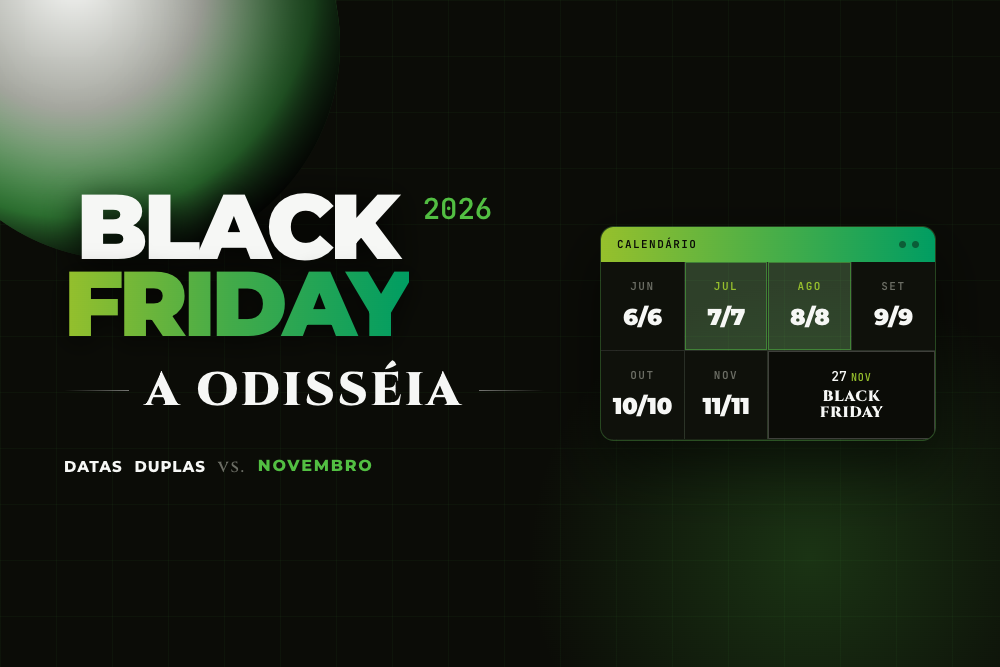
In July 2026, Mercado Libre recorded its biggest sales day ever in Brazil . It wasn't Black Friday . It was on 7/7 , one of the so-called double sales dates , which surpassed the performance of Black Friday 2025 itself in transaction volume, items sold, and unique buyers, according to E-Commerce Brasil . The record reignites a question that has been circulating among e-commerce managers and marketing directors: are double sales dates stealing the spotlight from the biggest sales day of the year?
The answer matters because it changes where digital retail invests money, inventory, and media. If consumers have started buying heavily year-round, betting everything on a single November peak is no longer the safest strategy, and paid traffic is the first channel to feel this.
On this page you will find:
Double dates and Black Friday: the essentials for 2026
- Mercado Libre's 7/7 sale in 2026 beat the company's own Black Friday sale in 2025.This is a sign that the demand concentrated in November is spreading throughout the calendar year.
- Double dates are commercial events on days with repeating numbers (7/7, 8/8, 9/9). Popularized by marketplaces and now established in the habits of Brazilian consumers;
- They favor those who have scale: As of February 2, 2026, marketplace GMV grew 107% year-over-year, with Mercado Libre up 158% and Shopee 143%, according to... ANYMARKET;
- Black Friday hasn't shrunk. In 2025, it grossed R$ 4,76 billion per day, an increase of 11,2% over 2024, according to... Trust Neotrust, remains the biggest date for retail;
- The choice is not double dates. ou B It's about understanding that sales are spread out, and the media operation needs to function year-round, not just on a single weekend;
- For the store that is not a large marketplace.The advantage lies not in creating dozens of dates, but in keeping paid traffic and data constantly active between them.
What are double dates and why have they become so popular?
Double dates originated in Asia and arrived in Brazil through large marketplaces. The logic is simple: transform days with repeating numbers into promotional events, with intense communication and facilitated shipping. What started as a one-off action has become a fixed calendar event. Today, consumers expect promotions on June 6th, July 7th, August 8th, and so on.
Growth is significant and concentrated among those with infrastructure. ANYMARKET data from February 2, 2026, shows the magnitude of the movement: a 107% increase in marketplace GMV compared to the previous year, with the number of purchases rising 78% and the average order value growing even faster. Mercado Livre and Shopee led the way, while players without the same structure of subsidies, logistics, and integrated payment advanced less.
This is the point that often goes unnoticed. Double dates don't just reward those who offer discounts; they reward those who combine price, fast delivery, and frictionless checkout—an operational advantage, not just a commercial one.
Black Friday 2026 remains the biggest retail event.
The record set on July 7th is impressive, but it doesn't mean Black Friday has lost its relevance. In 2025, e-commerce will have generated R$ 4,76 billion in revenue on Black Friday alone , the best result for the date since 2021, according to Confi Neotrust. And the outlook for the year remains positive: Abiacom projects R$ 259,8 billion in online sales in 2026 , an increase of around 15%. Black Friday 2026 falls on November 27th and continues to be the time when the largest number of consumers shop simultaneously.
The difference is one of nature, not size. Black Friday brings together virtually all retail (large marketplaces, own stores, niche brands) in a short window. Double dates are, in practice, marketplace territory, which uses its own calendar to drive demand whenever it wants; in other words, one thing doesn't cancel out the other. What has changed is the habit: Brazilians have become accustomed to finding good deals at various times of the year, and no longer save all their purchasing intentions for November.
Double dates or Black Friday? The answer lies in operating year-round.
When demand spreads across the calendar, the right question stops being "which date to invest in" and becomes "how to keep the sales machine running smoothly in between." This is where paid traffic makes all the difference.
Each commercial event (a double date, Customer Day, Black Friday) trains the algorithm of media platforms . Customer lists, well-marked conversion events, and qualified audiences built throughout the year arrive in November with accumulated learning. However, a brand that only engages with media during Black Friday week competes in the most expensive auction of the year with the algorithm still trying to understand who is buying. The cost per click rises, conversion falls, and the peak becomes an expense instead of a sale.
For stores that aren't large marketplaces, the solution isn't to imitate their calendar or create promotions every week. It's about using the year's dates as continuous touchpoints: keeping top-of-funnel campaigns running, fueling remarketing, and arriving at the big dates with an audience ready to convert. In this scenario, double dates cease to be a threat and become opportunities to warm up the customer base before Black Friday.
This analysis connects with what we've been showing in our video series about Black Friday: consumers only see the day of the offer, but the result is built on the operation behind it—strategy, data, traffic, and conversion working together over months.
The numbers that tell us if the strategy is on track.
Distributing effort throughout the year requires tracking the right metrics for each event, not just Black Friday. It's worth observing ROAS per campaign and per channel, the cost per acquisition over the months, the conversion rate per device, and the cart abandonment rate . Comparing performance between a double-header and Black Friday helps understand where the audience responds best and how to reallocate budget before the November peak. Data without interpretation is meaningless; what matters is what each number says about the next campaign.
The sale spread. Did your media outlet follow suit?
The record-breaking 7/7 sales figures aren't the end of Black Friday. It's a portrait of a consumer who buys year-round and a retail environment where media operations need to be constantly ready, not just in November. Double dates and Black Friday don't compete for your choice; together, they show that consistent results come from continuous strategy, organized data, and sustained paid traffic between peak periods.
If paid media is a central part of your revenue, now is the time to structure campaigns that span the calendar until Black Friday . The e-Plus Media Management team can help organize data, warm up audiences, and keep your strategy under control with automation for every date of the year . And, to continue the journey, explore the other content in the Black Friday series on the e-Plus blog.
Will double dates replace Black Friday? Quick answers
Are double dates making Black Friday the last straw?
No. Double dates spread demand throughout the year and already surpass Black Friday in specific marketplaces, such as Mercado Livre's 7/7 in 2026. But Black Friday remains the biggest retail date, with R$ 4,76 billion in revenue on that day in 2025, bringing the entire market together in a single window.
What is a double date in e-commerce?
Double date is a commercial event scheduled on days with repeating numbers, such as 7/7, 8/8, and 9/9. Popularized by marketplaces, it has become a fixed calendar of offers in Brazil. It works best for those who combine discounts, fast logistics, and integrated payment, therefore favoring large platforms.
When is Black Friday 2026?
Black Friday 2026 takes place on November 27th, the last Friday of the month, following the Brazilian pattern. However, the sales activity begins weeks earlier, with offers spread throughout the month of November in what is known as Black November.
Is it worth investing in paid traffic on double dates?
Yes, primarily as preparation. Running media campaigns on key dates throughout the year warms up audiences, feeds platform learning, and builds remarketing lists. This way, the brand arrives at Black Friday with a calibrated algorithm and a lower acquisition cost than those who only activate campaigns in the final stretch.