Every company, at some point, faces the same dilemma: the team is overloaded, tasks pile up, and the hours in the day seem insufficient. The curious thing is that, in many cases, the problem isn't the quantity of work, but the type of work being done.
The truth is that many professionals still spend a significant portion of their time on repetitive and manual tasks that could easily be automated. And this is precisely where Artificial Intelligence comes in as an ally for productivity . Intelligent automation isn't about replacing people, but about freeing them to think, create, and decide.
In this article, you'll learn how to apply AI to eliminate operational tasks, increase efficiency, and transform your company's routine.
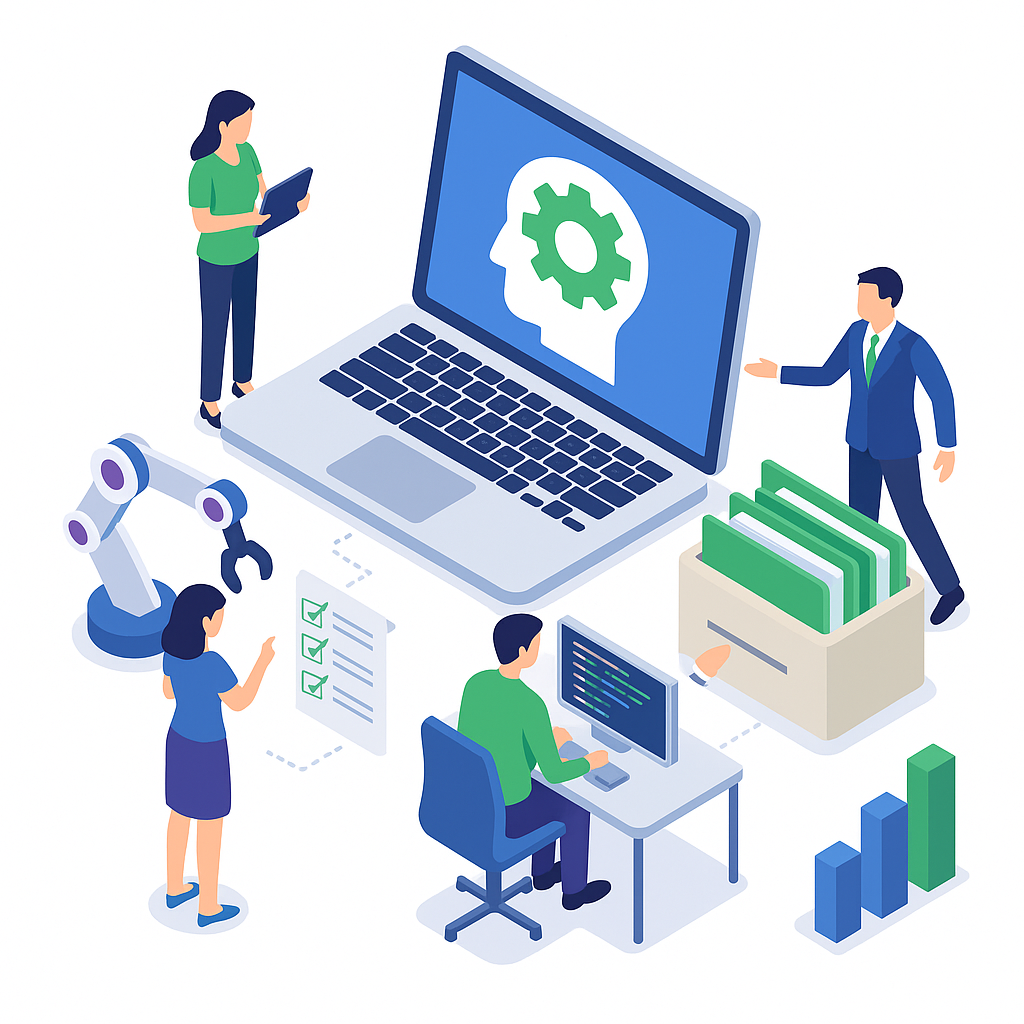
What is Intelligent Automation and Why is it Different from Traditional Automation?
Before diving into practical applications, an important distinction is worth making.
Traditional automation follows fixed rules. For example: "If a customer fills out a form, send a welcome email."
Intelligent automation , driven by Artificial Intelligence, learns from data and makes decisions based on patterns and context . It doesn't just execute commands; it understands, predicts, and adapts.
Imagine a customer service system that recognizes each customer's intent and decides the most appropriate response. Or a media tool that automatically adjusts campaign budgets based on real-time performance. These are real-world examples of intelligent automation in action.
The difference is that here there is no rigidity , there is learning. And that changes everything.
The direct impact of intelligent automation on productivity
When a company adopts intelligent automation, the effect is immediate: fewer manual tasks, more time for what really matters.
This translates into three clear benefits:
- Speed: processes that used to take hours are now executed in minutes.
- Precision: AI reduces human error and increases consistency.
- Efficiency : teams begin to focus on activities of greater strategic value.
Companies that implement intelligent automation report productivity gains of up to 40% and reductions of 25% to 35% in operating costs. These numbers vary, of course, but the pattern is the same: work becomes smarter and the business more competitive.
The perfect tasks to start automating with AI
Not everything needs to be automated. The secret lies in choosing tasks that are repetitive, data-driven, and have clear decision rules.
Some ideal examples to start with:
- Sending and segmenting emails based on customer behavior
- Automatic lead qualification in CRM
- Creating performance reports
- Updating records and internal information
- Initial support on digital channels
- Analysis of marketing campaigns and suggestion of optimizations
- Order processing and inventory control
These tasks are repetitive but crucial. When performed by humans, they take hours. When performed by AI, they happen in seconds and without fatigue. The result is a leaner, more agile team capable of delivering much more value.
How to identify what to automate first
Many companies wonder where to start. The answer lies in observing their day-to-day operations.
Ask yourself:
- Which activities are consuming the most of the team's time?
- Where do most errors occur due to distraction or rework?
- What processes depend on manual approval but could follow automatic flows?
- What tasks are repeated daily without the need for creativity?
List these activities and evaluate the impact of each if automated. You'll be surprised how much time you can free up for strategic tasks.
At e-Plus, for example, we've already conducted diagnostics in which a single automation reduced the execution time of internal processes from 4 hours to 15 minutes. And this without major structural changes, simply by reorganizing data and applying AI intelligently.
Real cases of intelligent automation
To understand the potential of this transformation, see some real-life examples of how intelligent automation is already having an impact in different areas:
Marketing and sales
A B2B company used spreadsheets to track leads and follow-up actions. With intelligent automation, the entire process is now managed by AI: leads are automatically classified, the hottest opportunities are prioritized, and emails are sent personalized. The result was a 45% increase in conversion rate and a significant reduction in response time.
E-commerce
An online store implemented AI to predict which products would be in highest demand in certain weeks. Based on this, the system automatically adjusts campaigns and inventory. The company reduced the volume of unsold products by 20% and increased revenue by 18%.
Customer Service
A financial services company created a virtual assistant trained to answer specific questions about contracts. Average support time dropped from 12 minutes to 3, and the support team focused on complex cases. Customer satisfaction increased by 22%.
These examples show that intelligent automation is not a future promise, it's a present reality.
The perfect combination: automation with human supervision
A common misconception is that intelligent automation works on its own. The truth is that the balance between AI and human oversight is what ensures sustainable results.
AI is fast, but lacks context. Humans are creative, but limited in volume. When the two work together, the result is powerful.
Eg
AI can generate daily performance reports and identify customer behavior patterns. But it's the manager who interprets this data, adjusts strategies, and makes decisions. Thus, automation doesn't replace humans, but rather multiplies your capacity to act.
Overcoming Internal Resistance
Every change generates resistance, and AI is no different. Many professionals fear losing their jobs, when in fact the opposite is happening. Intelligent automation frees people from mechanical work and places them in more strategic roles.
The best way to address this resistance is with transparency and training. Explain the purpose of automation, demonstrate the productivity gains, and involve the team in the process. When employees see that AI is an ally, engagement naturally increases.
How to Measure the Success of Intelligent Automation
Automating isn't enough; it needs to be measured. The success of an intelligent automation project is determined by clear indicators. Some of the main ones are:
- Reduction of time in operational tasks
- Increased team productivity
- Reduction of errors and rework
- Direct and indirect cost savings
- Employee and customer satisfaction
- ROI of AI investment
These metrics help demonstrate that the investment isn't just technological, but strategic. Automation is now seen as a pillar of growth and efficiency.
The Role of Leadership in AI Automation
No successful automation happens without leadership sponsorship. CEOs, directors, and managers need to view automation as part of a growth strategy, not a standalone project.
It's leadership's role to define priorities, direct resources, and communicate the purpose of the transformation. When the company's leadership is clear, the automation culture takes hold more quickly.
Additionally, leaders who embrace intelligent automation reap direct benefits: more accurate reporting, more predictable processes, and greater operational control.
Important precautions when automating with AI
Before automating everything, it's crucial to take certain precautions. AI needs well-structured data, clear processes, and realistic goals . Without these, the risk of waste increases.
Avoid starting with overly complex processes or those that rely on subjective judgment. Choose predictable tasks with concrete data and a high volume of repetition.
Another important point is security. Ensure that the data used is protected and compliant with the LGPD. Automation should generate efficiency, never vulnerability.
Results that go beyond numbers
Productivity gains are evident, but there's a less tangible yet equally valuable benefit: the transformation in how we work . Teams that adopt intelligent automation become more analytical, collaborative, and strategic. The organizational climate improves, and people feel they are producing more with less burnout.
In this context, AI becomes a symbol of evolution. It shows that the company is open to the future, that it values its employees, and that it understands the power of technology when used purposefully.
The e-Plus methodology for intelligent automation
At e-Plus, we treat intelligent automation as a structured process, divided into three stages:
- Diagnosis and mapping
We understand operational flows, identify bottlenecks, and map out ideal tasks for automation. - Implementation and integration
We apply AI and automation to the tools already used by the client, ensuring integration with CRM, ERP, and internal systems. - Continuous monitoring and optimization
We measure results, adjust flows and continually seek new profit opportunities.
This model ensures that each automation has purpose, impact, and sustainability. The result is a smarter, more competitive operation.
Conclusion
Intelligent automation is one of the fastest and most effective ways to apply Artificial Intelligence with real returns. It transforms wasted time into strategic value, increases productivity, and prepares the company for a new level of efficiency.
The technology is already available. The next step is to start with purpose, strategy, and the right partner. When done correctly, automation doesn't just accelerate processes. It accelerates growth.
Quick FAQ
1. What is the difference between traditional automation and intelligent automation?
Traditional technology follows fixed rules, while intelligent technology learns from data and makes decisions based on patterns and context.
2. Which tasks should I automate first?
Those that are repetitive, manual, and time-consuming, such as reporting, basic support, or lead segmentation.
3. Will AI replace my team?
No. It complements human labor, eliminating operational tasks and freeing up time for strategic decisions.
4. How long does it take to see results?
Typically between 30 and 90 days, depending on scope and integration with existing systems.5. Is intelligent automation expensive?
No. The investment usually pays for itself quickly through time savings and reduced operating costs.
Want to learn how to automate processes and free up time for what really matters? e-Plus helps your company implement intelligent automation with AI, integrating technology and strategy to generate real productivity.
Chat with e-Plus and see how to transform your operation with Artificial Intelligence.