Retail media has become one of the most competitive areas of digital commerce. The logic is straightforward: the retailer already has the traffic, the purchase data, and the right timing ; what's lacking is the infrastructure to transform all of that into advertising revenue. This is the space that VTEX Ads occupies, with an omnichannel platform that connects retailers who want to monetize their traffic with brands that want to reach high-intent shoppers.
In this content, you'll understand what the VTEX Ads Platform is, what formats and features it offers, how pricing works, and who the model makes sense for.
In this article you will read:
VTEX Ads: the essentials to get started
- It is VTEX's omnichannel Retail Media platform.: gathers advertisements on-site (within e-commerce), Off site (outside of it) and InStore (physical store) in a single ecosystem, with closed-loop attribution.
- It caters to three profiles.Retailers looking to monetize traffic, brands seeking to reach high-intent buyers, and agencies managing multiple clients.
- Generates high-margin incremental revenue.The retailer sells the advertising inventory from its own website without relinquishing control over the user experience, adhering to brand safety rules and curating which brands advertise.
- Activation is immediate for VTEX customers.With API-First architecture and a Plug and Play model, the Retail Media operation can go live in days, not months.
- The numbers released by VTEX indicate the potential: 17x average ROAS in Electronics, 63% conversion rate in Pharma, and over 3 billion views per month, on average across the platform.
What is VTEX Ads Platform?
VTEX Ads Platform is VTEX's Retail Media solution , designed for two sides of the same ecosystem. On one side, the retailer who wants to create a profitable media operation without the operational complexity of setting everything up from scratch. On the other, the brand or agency that wants to advertise exactly where the purchase decision happens.
For retailers, the proposal is to open a new high-margin revenue stream by monetizing the website's ad inventory. According to VTEX , a Retail Media operation can access the equivalent of about 2% of the retailer's GMV, revenue that currently tends to remain unused. And this happens without losing control of the shopping experience: the platform allows defining brand safety rules, controlling which brands appear, and monitoring everything in a unified dashboard, with metrics on media revenue, advertiser ROAS, and performance by category.
Onsite, Offsite e InStoreRetail Media across all channels
The key differentiator of VTEX Ads is uniting the three advertising environments into a single management system. Onsite ads are those within the e-commerce platform itself; Offsite ads reach the buyer outside the website; and InStore ads take the media to the physical point of sale. With reports that track conversions across all three, the retailer closes the performance loop and understands the real impact of each touchpoint, something difficult to do when each channel runs on a separate tool.
VTEX Ads ad formats
The platform covers the formats that accompany the entire buyer's journey, from discovery to conversion:
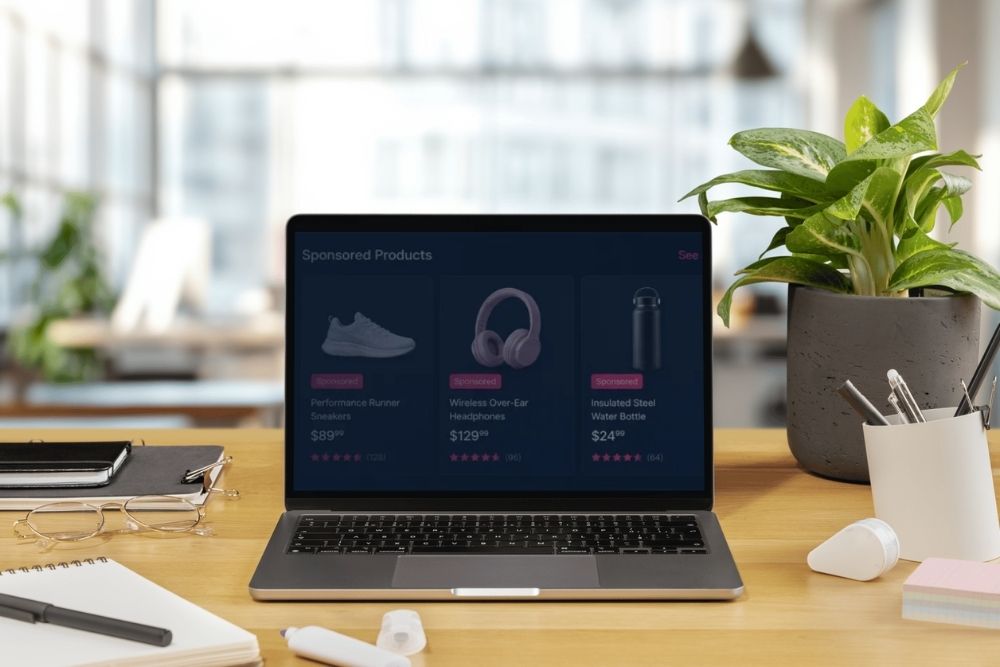
- Sponsored Products: Product ads on the most relevant pages, with visibility at the moment of decision.
- Sponsored Search: Presence at the top of e-commerce search results, capturing those who are already searching for a product.
- Sponsored Window Displays: Product highlighting on the homepage and category pages, during discovery phases.
- Displays & Banners: Pieces placed in high-impact positions for engagement and brand recognition.
- Sponsored Brand: High-impact banners combined with sponsored products on the most strategic pages.
- Video Banner: Videos in premium positions, combining brand storytelling with high purchase intent.
Resources that support the results
Behind the formats, VTEX Ads brings together capabilities focused on performance and scale. Bid Monitor tracks bids in real time and automatically adjusts strategies to maximize ROAS without manual effort. Advanced targeting uses first-party data unique to the retailer, without relying on third-party cookies, a point that is increasingly relevant with the gradual end of traditional tracking.
Multi -attribution measures the true impact of each touchpoint throughout the journey, and unified reports consolidate onsite, offsite , and in-store traffic conversions . For larger operations, the multi-retailer and multi-brand model allows you to manage multiple customers in a single instance.
There's also the artificial intelligence layer. With VTEX Creative Studio, the Banner Generator automatically creates pieces for 171 ad formats, adapting colors and text without losing brand identity, while Image to Video transforms static banners into animated videos , useful for video formats on any channel. The idea is that AI agents will help create, visualize, and optimize campaigns throughout the entire cycle, from strategy to execution.
Pricing models: CPC, CPM, and daily rate.
VTEX Ads works with a prepaid model that's free of red tape: advertisers add their card, deposit the desired amount, and start advertising, with no contract and no minimum investment. Billing adapts to the campaign's objective.
| Córdoba | How works | Indicated for |
| CPC (Cost Per Click) | You only pay when the user clicks on the ad. | Campaigns focused on traffic and conversion. |
| CPM (Cost Per Thousand Impressions) | You pay for every 1.000 impressions displayed. | Brand recognition and reach |
| Daily Rate (Cost per Day) | Fixed rate per day of exclusive viewing. | Key actions and guaranteed presence |
This format gives the advertiser complete control, who pays according to the results each campaign aims to generate.
For whom does VTEX Ads make sense?
The platform was designed for three profiles, with distinct gains for each. Medium and large retailers find in VTEX Ads a way to monetize the traffic they have already acquired, opening up a media revenue stream that doesn't depend on selling more products . The brand gains a channel to appear at the exact moment of the purchase decision, using primary retailer data for precise segmentation. And the agency can run campaigns for multiple clients in a single instance, without multiplying the complexity with each new account.
The common thread is the combination of scale and control: formats for the entire journey, closed-loop attribution, and rules that preserve the shopping experience and brand safety.
How to take the first step with VTEX Ads
Setting up a Retail Media operation yields better results when the technological foundation is well-structured, and that's where a partner makes all the difference. e-Plus works on the implementation, migration, and evolution of operations on VTEX, helping brands and retailers get the most out of platforms like VTEX Ads.
If your company wants to structure, migrate, or evolve an operation on VTEX to explore the potential of Retail Media, talk to the e-Plus team of experts.
Frequently asked questions about VTEX Ads
What is VTEX Ads?
VTEX Ads is VTEX's omnichannel retail media platform. It allows retailers to monetize their e-commerce traffic by selling advertising space, and enables brands to advertise to high-intent shoppers. It brings together onsite, offsite, and in-store ads in a single ecosystem with unified reporting.
How does VTEX Ads generate revenue for the retailer?
The retailer starts selling its own website's advertising inventory, such as sponsored products, banners, and storefronts. This creates a high-margin incremental revenue stream without new inventory costs. According to VTEX, a Retail Media operation can access the equivalent of approximately 2% of the retailer's GMV.
Do I need to be a VTEX customer to use VTEX Ads?
Activation is Plug and Play for VTEX clients, thanks to the API First architecture, allowing the operation to launch in days. For those not yet on the platform, structuring this foundation (via deployment or migration to VTEX) is the first step to enabling Retail Media.
How much does it cost to advertise on VTEX Ads?
The model is prepaid, with no contract and no minimum investment: the advertiser deposits the amount they want and gets started. Billing follows three formats depending on the objective – CPC (per click), CPM (per thousand impressions), and daily (fixed rate per day of exclusive display).