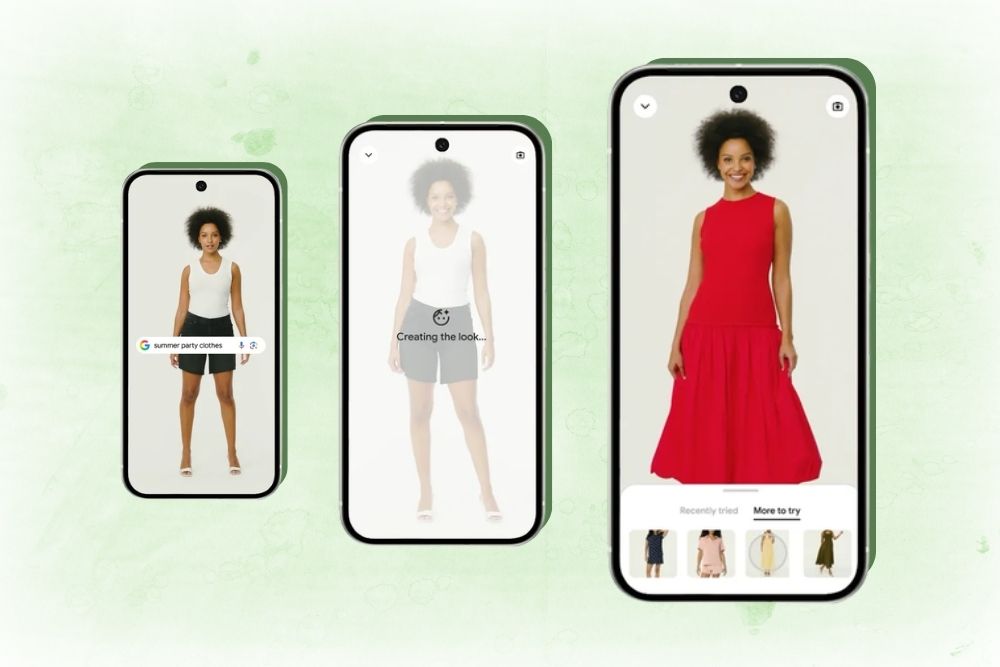
One of the biggest barriers to fashion e-commerce has always been uncertainty. Questions like " Will this item match my skin tone? " or " How will it fit my body? " generate hesitation that often results in an abandoned shopping cart or, worse, a return. However, this reality is about to change drastically. The newest frontier of innovation for the sector is Google's virtual fitting room (" Try it on ") , a tool that promises to solve this issue definitively.
Unlike previous technologies, this new approach allows consumers to see the clothes on their own bodies using a personal photo. Consequently, the shopping experience becomes hyper-personalized and much more reliable. In this article, we'll delve into how this incredible AI technology works and what revolutionary impacts it will have on retailers and consumers.
HOW DOES GOOGLE'S NEW VIRTUAL FITTING ROOM WORK?
Imagine you're browsing an online store, you find a dress you love, but you're unsure about the fit. With Google's new tool , the process becomes much more tangible: you simply upload a photo of yourself standing, full-body, and Artificial Intelligence kicks in, generating an image of you "wearing" the garment.
Ultimately, as detailed on Google's official blog and on portals like Canaltech , it's not a simple montage or "pasting" clothes onto your photo. The technology behind this magic is much more sophisticated.
The technology behind the image: Advanced generative AI
The feature uses a fashion-focused image generation model. This model was trained to understand not only the appearance of a piece of clothing, but also its physical behavior.
By analyzing your photo, the AI identifies your pose, body type, and proportions. Then, it not only positions the clothing on you but realistically simulates how the fabric of that specific garment would behave on your body , considering:
- Fit: how the fabric falls and molds to your curves.
- Shadows and folds: creating realistic shadows and creases that add depth and show how the garment fits.
- Texture: the way light interacts with the surface of the fabric.
This means that the result is an image that is extremely faithful to reality , offering an accurate preview of how the garment would look in a real fitting.
THE DIRECT IMPACT ON THE CONSUMER AND THE RETAILER
The ability to “see” yourself in a product before you buy it isn’t just a fun feature, it’s a business tool with a profound impact on both the buyer and the seller.
For the consumer: the end of uncertainty
For the customer, the benefit is clear and immediate: the end of buying "blindly." The main advantage is hyper-personalization. Seeing the garment on one's own body, and not on a model, eliminates most doubts about fit, proportion, and compatibility with skin tone. This clarity generates a level of confidence in the purchase decision that was, until now, impossible to achieve in the online environment.
For the retailer: the double win of conversion and profitability
For e-commerce owners, Google's Virtual Fitting Room directly addresses two of the industry's biggest challenges.
- Conversion rate increase: A more confident consumer will hesitate less. The likelihood of a customer who saw themselves and liked the simulation results clicking the "Buy" button is exponentially higher.
- Drastic reduction in returns: a reverse logistic is one of the largest operating costs in online fashion. The main reason for returns is “improper size or fit"By enabling accurate virtual try-ons, the tool has the potential to drastically reduce the number of exchanges and returns, directly impacting the business's profit margin.
CONCLUSION: THE FUTURE OF FASHION IS WITH AI
Google's virtual fitting room, which uses the user's photo, is not just an incremental update; on the contrary, it's a leap forward in the online shopping experience. After all, it transforms fashion e-commerce from a product showcase into an interactive personal style consultant . By solving the chronic problem of uncertainty, the tool benefits the entire ecosystem: consumers make smarter and more satisfying purchases, and retailers increase their sales while reducing their operating costs.
Although the feature doesn't yet have an official release date in Brazil , it clearly points to the future of the sector. Without a doubt, we are facing a technology that will become an industry standard in the coming years, and brands that prepare to adopt it as soon as it becomes available will be ahead of the curve.
Want to stay ahead and understand how new AI technologies can revolutionize your e-commerce? Keep exploring the articles on the e-Plus blog and prepare your business for the future.