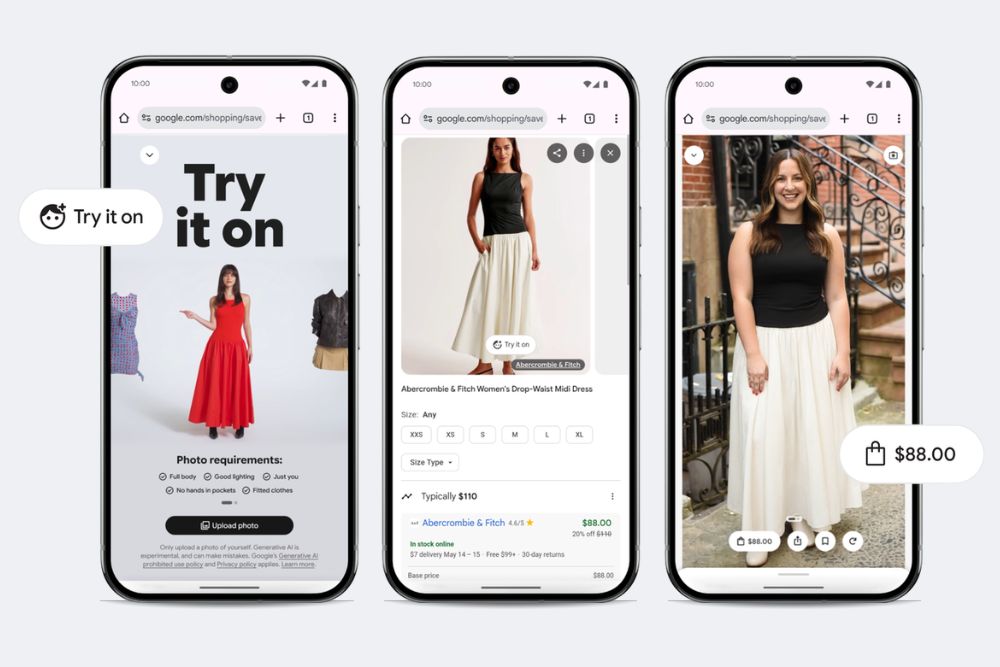
The fashion shopping journey in the digital environment has historically faced the barrier of the impossibility of physical trying on . To overcome this restriction, the market is witnessing a transition driven by generative technologies. The recent launch of Google's AI-powered virtual fitting room in Brazil is changing how consumers interact with digital retail. By allowing consumers to digitally try on items before checkout, the tool aims to bring the security of fit and texture from physical stores directly to screens, reshaping expectations for navigation, retention, and conversion on online platforms.
In this article you will read:
The essentials about the new feature.
- What is the main purpose of the tool? The solution aims to reduce insecurity in online shopping, bringing the digital experience closer to the real-life experience of a physical fitting room.
- How does the technology work? The system uses generative artificial intelligence integrated to Google Shopping to simulate with a high degree of realism the fit of garments on different body anatomies.
- What does the user need to do? Simply search for a fashion item, select the option “Try On the Look"and send a full-body photo to try on clothes and shoes in just a few seconds."
- Where is the feature displayed? The feature tests billions of clothing items directly in the traditional Search, in the tab. Shopping and also in the results of Google Images.
- Which products are active in the system? In this initial implementation phase, only products listed for free on the platform will be available for consumers to try.
The virtual fitting room simulation mechanics with IA
The evolution of artificial intelligence applied to customer experience solves limitations that we have seen for some time in e-commerce. Unlike traditional tools, which only worked by artificially overlaying two-dimensional images onto the user's photo, Google's system was structured with an AI model customized exclusively for the fashion retail sector.
The tool's computational capacity operates analytically and spatially. The technology can interpret the physical behavior of materials, calculating exactly how different fabrics stretch, bend, and adjust to various body types and poses. This results in a faithful visualization of the final product, respecting volumes, shadows, and the actual drape of the clothes. For Patrícia Moreira , Head of the Fashion and Beauty Industry at Google Brazil , this transition ensures that the inherent confidence of fitting rooms is brought directly to the screen of a cell phone or computer.
the role of Shopping Graph in the strategy of the shopkeepers
The technical feasibility of the AI-powered virtual fitting room is supported by a massive data architecture: the Shopping Graph . This is the company's data structure developed to integrate the entire shopping ecosystem , connecting catalogs, brands, inventory, and product attributes in real time.
For e-commerce managers, the intersection of generative AI with the Shopping Graph reinforces the importance of data structuring. Since the system processes fashion items from free searches, online stores that keep their product feeds perfectly optimized (with high-resolution photos, detailed descriptions, and exact fabric and design specifications) facilitate the algorithm's work.
The browsing journey also increases the consumer's contact time with the product. The interface designed by Google allows users to save various combinations and share looks with others even before accessing the retailer's website to complete the purchase. This prior engagement acts as a strong traffic qualifier.
Transformation in return rates and trust in e-commerce.
The financial and operational impact of this technology goes far beyond visual appeal. In the fashion segment, the lack of predictability regarding clothing fit is the main driver of shopping cart abandonment and high reverse logistics rates . The cost of return shipping and inventory reprocessing drastically reduces profit margins.
By delivering an accurate visual representation, the technology provides the necessary data for an assertive decision, mitigating returns motivated by frustration with the size or aesthetics of the garment on the body . Google 's launch points to a new moment in e-commerce, establishing that personalized visualization, convenience in the testing process, and consumer trust are now central to end-to-end conversion strategies.
To deepen your understanding of the impact of artificial intelligence on retail operations and discover up-to-date methodologies for optimizing your brand's online sales results, follow the other articles, analyses, and reports published on the e-Plus blog.
FAQ – Frequently Asked Questions about the Google AI-powered Virtual Fitting Room
How do I use Google's experimentation feature?
The consumer must search for a piece of clothing on Google, click the "Try the Look" button, upload a full-body photo, and wait for the rendering. The simulation result appears on the screen in a few seconds.
What is the difference between Google's AI and older virtual fitting rooms?
Traditional tools only overlay flat images. Google's customized model uses generative AI to accurately interpret and reproduce how different materials bend, stretch, and conform to the anatomy of the uploaded photo.
Are all the clothes from all the online stores in the fitting room?
No. The system processes billions of items available on Search and Shopping, but in this launch, its functionality primarily encompasses products listed for free in the Google Shopping ecosystem.