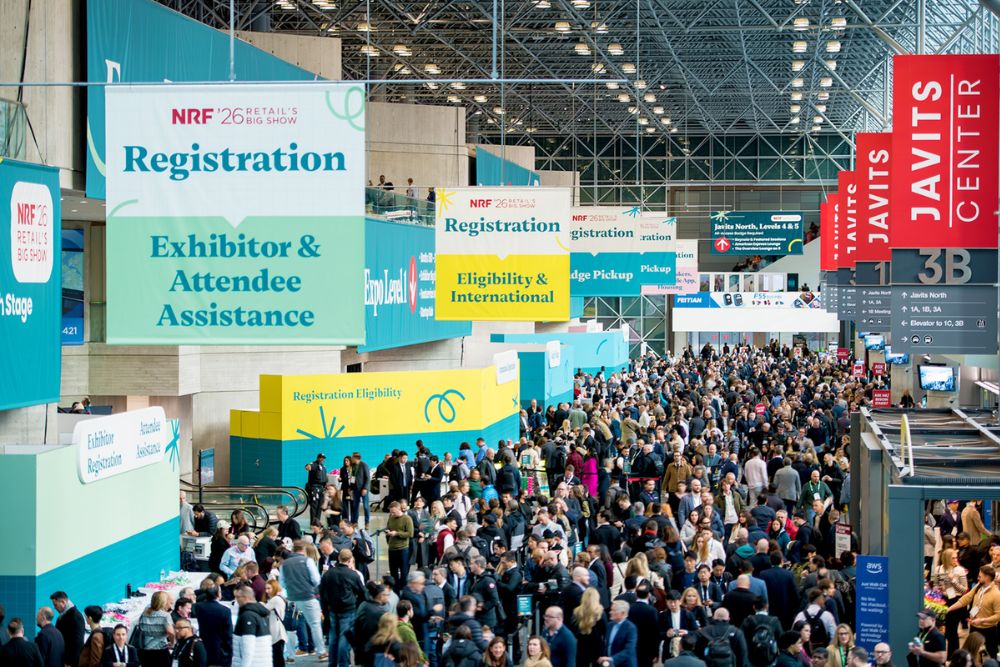
Global retail has just undergone a new revolution in New York , and the message from NRF 2026 was clear: we have entered the era of autonomous execution . Currently, many still struggle to implement basic chatbots or simple personalization, believing that this is innovation. However, the scenario changed drastically between January 11th and 13th . Insisting on tools that only "suggest" actions instead of executing them has become an immense operational risk.
Unfortunately, the consequence of not keeping up with this change is brutal. While you analyze spreadsheets to decide on restocking or offers, competitors who have adopted the technologies presented at NRF already have AI agents negotiating directly with consumers' virtual assistants . Consequently, your Customer Acquisition Cost (CAC) skyrockets, your operational efficiency stagnates, and you lose relevance to algorithms that now make purchasing decisions.
To solve this, it's urgent to understand the concepts of " Agentic Commerce " and " Intelligent Execution ." Therefore, in this article, we present the main trends from NRF 2026 and, more importantly, we'll show you how to apply them to your operations to protect your ROI and secure the future of your business.
IN SUMMARY: WHAT WE WILL COVER ABOUT NRF 2026
- The main theme: a NRF 2026 marked the official entry into theEra of Agentic Commerce(Agency Trade).
- Technology: Google announced protocols for Agentic AIallowing AIs to purchase products on behalf of users.
- The operational focus: "Smart Execution" replaces static planning; now, technology acts to correct courses in real time.
- The consumer: requires hyperpersonalization It is fluid and values the circular economy not only for ethical reasons, but also for cost-effectiveness.
- The impact in Brazil: Global trends are already influencing national retail, requiring rapid adaptation in payment methods and logistics.
1- The Rise of “Agentic Commerce” (Agentic AI)
First and foremost, the most disruptive trend presented is undoubtedly Agentic Commerce . While in previous years we talked about Generative AI (which creates texts and images), at NRF 2026 the focus shifted to AI that acts. According to experts present at the event, retail is entering an era where virtual assistants not only answer questions but also carry out complete transactions.
What changes in practice?
During the event, Google announced a specific protocol for the use of Agency AI in e-commerce . This means that, soon, your website will need to convince not only a human, but also the "robot ." The consumer AI agent will search for the product, compare prices, check stock, and make the purchase.
Upon closer analysis, this drastically alters SEO and UX.
- Impact on ROI: If your website isn't readable by these agents (structured data, open APIs), you'll disappear from the buyer's radar.
- Strategy: The online store needs to be prepared formachine-to-machine commerceand ".
2- The Era of Intelligent Execution
Furthermore, another central pillar of NRF 2026 was " Intelligent Execution ." Often, companies have an excess of data but fail at the final stage: action . The event highlighted that the competitive advantage now lies in the ability to execute complex tasks in an automated and precise way.
For example, instead of a marketing analyst looking at a dashboard and deciding to lower the price of a slow-moving item, intelligent execution systems identify the trend, calculate the margin, and apply the dynamic discount instantly across sales channels.
In this context, operational efficiency becomes the new marketing metric.
- Cost reduction: Less human error and fewer hours spent on repetitive tasks.
- Agility: Immediate reaction to competitor moves or changes in demand.
Terms that are dominating the new retail landscape.
| THERMO | MEANING |
| Agentic Commerce | Agent Commerce. Refers to transactions facilitated or executed entirely by autonomous software agents (AIs) on behalf of consumers or businesses. |
| Smart Execution | Intelligent Execution. The use of technology to close the gap between planned strategy and actual operation, ensuring that actions are performed automatically. |
| Seamless Experience | Seamless experience. Purchase journeys where there is no friction between channels (online, app, physical store). |
3- Hyper-personalization and the “end” of Generic Segmentation
Although personalization is a recurring theme, at NRF 2026 it reached a new level . Trends indicate that segmentation based solely on demographic data (age, location) has become obsolete. Now, the focus is on understanding context in real time.
In fact, the technologies presented allow the store to understand not only "who" the customer is, but "when" they are in their shopping experience. Are they buying in a hurry on their mobile phone using 4G? Or are they browsing calmly on a desktop computer with Wi-Fi? The interface and the offer adapt to this.
From a Lifetime Value (LTV) perspective , this is crucial. Customers who feel individually understood tend to buy more frequently and with higher average order values, diluting the impact of the initial Customer Acquisition Cost (CAC).
4- Sustainability as Profit (Re-commerce)
Another point that has gained traction and is already influencing Brazilian retail is the vision of sustainability as a business . The resale market ( or re-commerce ) has been discussed as an essential strategy for customer retention and attracting Generation Z.
Therefore, brands that implement " trade-in " programs (exchanging used items for credit) or sell " open box " items are creating new revenue streams.
- Our point of view: This isn't just for thrift stores. Large electronics and furniture retailers also do it. They can use this trend to increase purchase frequency.bringing the customer back to the store to recycle and buy the new model.
5- The Brazilian Retail Sector and Immediate Adaptation
Finally, it's essential to connect New York to Brazil. The trends from NRF 2026 no longer take years to arrive here; they land in weeks. The national retail sector is already feeling the pressure for more seamless experiences and the use of AI at the point of sale.
However, implementation in Brazil faces challenges related to infrastructure and integration . This is where a technical perspective makes all the difference. There's no point in wanting " Agentic Commerce " if your ERP system doesn't communicate with your e-commerce platform in real time.
The recommended strategy is to start from the basics:
- Data cleansing (to feed AI).
- Full channel integration (Unified Commerce).
- Gradual adoption of autonomous agents for low-risk tasks.
CONCLUSION: EXECUTION AS A DIFFERENTIATOR
In short, NRF 2026 made it clear that technology has ceased to be a support and has become the main driver of commerce . "Guesswork" and slow manual operations have become unsustainable luxuries. Whoever masters Agency AI and Intelligent Execution will lead the market; whoever ignores it will be bought by competitors' AI agents.
Therefore, the moment calls for technical professionalization. e-Plus operates at the forefront of this innovation, helping companies prepare their digital infrastructure to receive these new technologies . We transform global trends into real and secure implementation processes.
Is your store ready to sell to robots, or are you still having trouble selling to humans?
[Talk to an e-Plus specialist and design your e-commerce innovation roadmap for 2026.]
FAQ – FREQUENTLY ASKED QUESTIONS
What is Agentic Commerce (Agency Trade)?
Basically, it's the evolution of e-commerce where Artificial Intelligence agents act autonomously. In other words, instead of the user browsing and clicking, they ask their personal AI to find, negotiate, and buy a product, and the store's system interacts with this robot.
How does NRF 2026 impact retail in Brazil?
Trends such as the use of AI for execution and profitable sustainability are already influencing the national market. Therefore, Brazilian companies need to accelerate digitization and data integration to avoid losing competitiveness to global players who are already using these tools.
How much does it cost to implement Smart Execution?
The cost varies depending on the complexity of the operation. However, the initial investment in automation tools usually pays for itself quickly through reduced operational errors and increased efficiency in inventory and pricing management.
What is the difference between Generative AI and Agency AI?
Generative AI (like traditional ChatGPT) creates content (text, image). Agency AI, on the other hand, has the autonomy to perform actions in the digital world, such as filling out forms, processing payments, and making decisions based on predefined parameters.