Inbound Marketing metrics are indicators that allow you to measure how efficient (or not) your Inbound Marketing project is . They are especially useful for helping you make comparisons, discover errors, and think about interventions that can improve your business performance.
Just to put it in context, Inbound Marketing, for those who don't know, is an aspect of Marketing that is based on publishing content. Content, in this case, aims to attract, convert, relate and delight consumers, first turning them into leads (contacts) and then into customers (buyers).
The content I am referring to can be, for example, published in the form of a blog post, sales page in a virtual store, e-book, infographic, video and E-mail Marketing messages. In addition, formats such as lists, tutorials, webinars, lives and podcasts, among others, are used.
Inbound Marketing is a very powerful outreach strategy and could be the resource you've been looking for to boost your e-commerce business. Just to give you an idea, here are some numbers that illustrate the performance of Inbound Marketing (according to HubSpot ):
- 47% cheaper to get a lead through Inbound than with Outbound Marketing;
- 92% of companies that use Inbound get a positive return;
- 41% of B2C business leads and 47% of B2B business leads come from Inbound.
Finally, by applying such a project to your e-commerce, you will be able to measure the results through Inbound Marketing metrics. In this way, it will be possible to keep an eye on the evolution of your business and, in addition, obtain insights for continuous improvements.
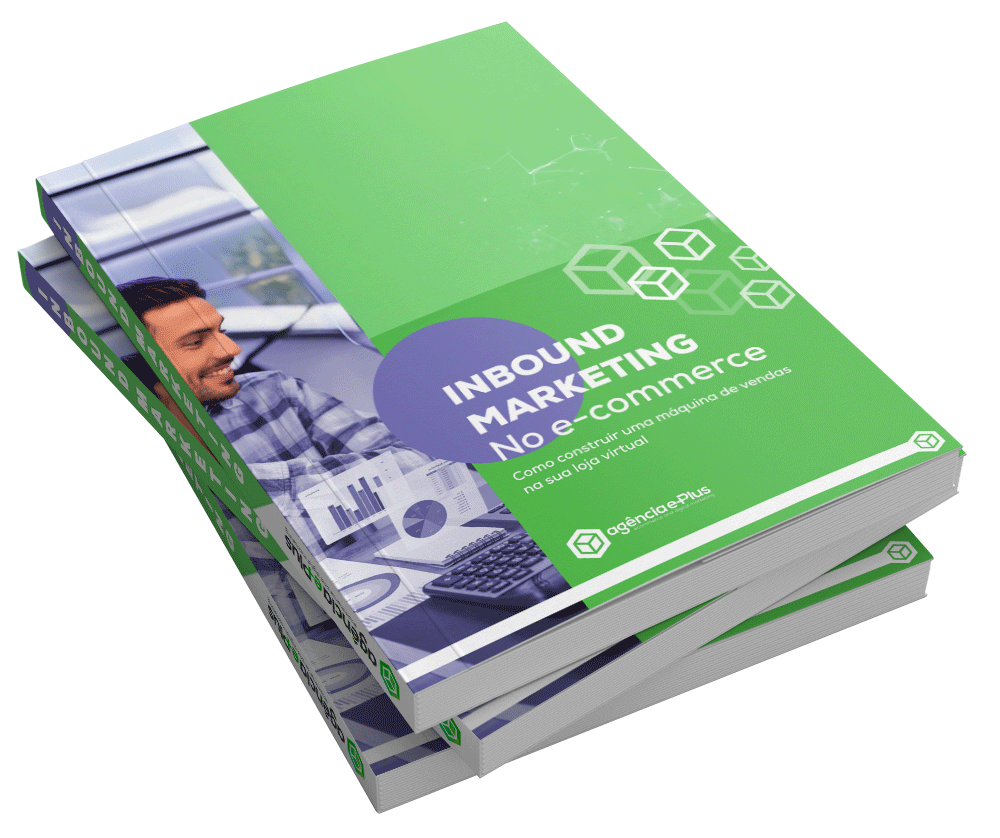
Inbound Marketing in E-commerce
Click the button below to download the free e-book "Inbound Marketing for E-commerce" produced by Agência e-Plus!
10 INBOUND MARKETING METRICS
These are Inbound Marketing metrics:
1 – Number of visitors
The more traffic you can drive primarily to your online store, the better. This is why the “number of visitors” metric is so important. Through it, you can evaluate which channels send the most visitors to your sales pages and get ideas to improve performance.
2 – Cost per visitor
By dividing the total number of visits by the amount invested in advertising over a period, you get the “cost per visitor”. This is one of the Inbound metrics that allow you to visualize your project costs. Keep an eye on these numbers and try to cut out superfluous activities to reduce spending.
3 – Lead conversion rate
To find the “conversion rate”, divide the number of new leads by the audience in a period, and multiply by 100. For example, 148 new contacts divided by 5.000 visitors in the month of October represents 2,9%. It is possible to measure the conversion rate of leads by period and by channel.
4 – Lead qualification rate
Measure the “lead qualification rate” by dividing the number of regular leads by the qualified ones (who went through the lead nurturing process). Here you will get a percentage that will give you an idea of how many consumers are aligned with your publicity speech.
5 – Cost per lead
The “cost per lead” is the amount of your Marketing investment divided by the number of new leads in a period. For example, if you spent $2.500,00 to generate 337 leads in November, that means your cost per lead was around $7,41 for the period.
6 – Sales conversion rate
The “sales conversion rate” is dividing the number of customers by the number of leads in a period, times 100. So, if 32 of the 100 leads you acquired in a month became customers, then your sales conversion rate sales was 32% in the period.
7 – Customer Acquisition Cost
The “Customer Acquisition Cost” (CAC) is the investment and expenses divided by the number of customers acquired in a period. So, if you spent R$5.000,00 and acquired 444 customers in the month, your CAC was approximately R$11,26.
8 – Email conversion rate
The “email conversion rate” is dividing the number of people who completed the action requested in the message by the number of emails you sent times 100. So if you sent 10.000 emails and 678 people completed the action, the rate was 6,78%. The higher the rate, the better.
9 – Rejection rate
Bounce rate is the percentage of people who visited a page and left without visiting another. To calculate, divide the sessions without interaction by the total number of sessions and multiply by 100. So, if 200 people visited your page in April and 160 left without visiting any others, the bounce rate was 80%.
10 – Return on Investment (ROI)
Return on Investment is the relationship between revenue (positive or negative) and the amount of money invested in an e-commerce. To calculate, subtract the investment from the return, divide the result by the investment and multiply by 100. For example, if in one month you invested R$150.000,00 and earned R$440.000,00, then your ROI was 193%.
Track these and other Inbound Marketing metrics daily, as this will allow you to generate ideas for improving your e-commerce performance at all times. And if you need help with this process, just contact Agência e-Plus , which you can do by clicking the button below and starting a conversation with us via the messaging app: