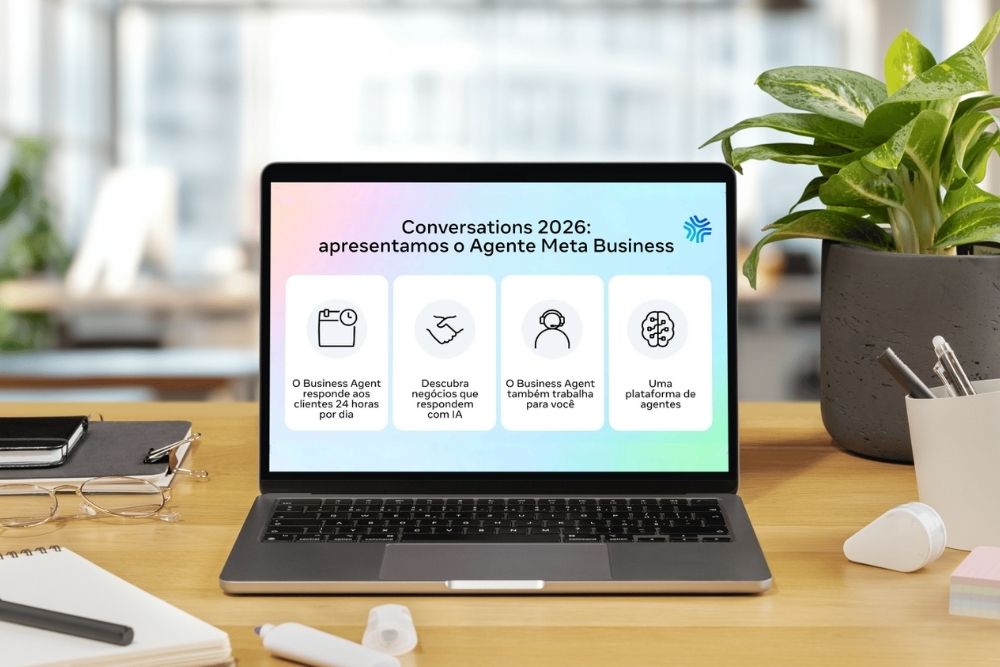
We can say that WhatsApp today is the "sales counter in Brazil." The WhatsApp Consumer Behaviour research , commissioned by Meta and conducted by Offerwise in January 2025, shows that 89% of Brazilians already use the app to communicate with stores and service providers. It is in this area (where the customer already is and already buys) that Meta has just placed its artificial intelligence. The Meta Business Agent , announced by Mark Zuckerberg on June 3, 2026 at the Conversations event in London, includes an automated customer service agent directly in WhatsApp, Messenger, and Instagram.
For those working in digital retail, the change is most significant for those controlling the AI layer of the conversation. Until now, automating customer service on WhatsApp required hiring a partner platform. Meta now offers this natively, within the apps themselves, with setup in minutes . Therefore, in this article, we explain what the tool is, what it does, who it's suitable for, and where it connects with your customer acquisition strategy.
In this article you will read:
Key points about the Meta Business Agent
- It is a native AI agent from Meta.: automatically responds to customers in WhatsApp, Messenger and Instagram, in the consumer's language and in the tone of voice defined by the company;
- It does more than just answer questions.It recommends products from the catalog, schedules appointments, qualifies leads, helps close sales, and transfers the case to a human agent when the company determines.
- It starts out free, but there will be a charge.Initial activation is free. However, the Meta confirmed paid subscription plans in the coming months, with charges based on usage (token usage) for large companies;
- It was already being produced on a large scale before the launch.Over 1 million companies used previous versions of the agent in pilot programs that included Brazil, Mexico and India;
- There is a version for large operations.: Meta Business Agent Platform allows you to build and integrate agents into more than 100 systems, such as Shopify and Zendesk and, in Latin America, to cloudshop;
- It depends on the volume of conversations to generate results.The agent only assists those who come to them; without a flow of new contacts, automation serves few people.
What is Meta Business Agent in practice?
Meta Business Agent is an AI assistant that companies activate within the WhatsApp Business app, Instagram Pro, Messenger, or Meta Business Suite . Meta's proposition is that any business, of any size, can have an agent responding to customers 24 hours a day without needing to build its own customer service structure.
In his London presentation , Zuckerberg summarized the idea as giving each company an agent to talk to customers and help run operations. The agent operates in the customer's local language, adopts the brand's communication tone, and allows the company to define when the interaction is transferred to a member of the team.
The number that gives dimension to the movement is about the channel: Meta claims that more than 1 billion conversations between people and companies already occur daily across WhatsApp, Messenger, and Instagram. AI comes in precisely to handle this volume, something that no human team can cover alone.
The announced functions
Meta listed a set of tasks that the agent performs within the conversation :
- answer questions about the company and its products;
- recommend items from the catalog;
- Schedule appointments and services;
- Qualify leads before passing them on to the sales team;
- to support closing sales;
- Summarize conversations and deliver a "morning summary" of what was discussed during the night.
In the future, the company intends to expand the agent's role to include behind-the-scenes tasks such as market research, scheduling, and competitive intelligence.
What changes in relation to what already existed?
Automating customer service on WhatsApp is nothing new in Brazil, but what's different is the source of the technology. Previously, the conversational intelligence came from third-party platforms contracted by the company. Now, Meta offers its own embedded AI layer that can be activated quickly.
This lowers the barrier to entry for small and medium-sized retailers, who can connect a basic agent in minutes. At the same time, it creates a strategic question for larger operations: the native agent covers the essentials (frequently asked questions, catalog, scheduling), but it's designed to function similarly for everyone. It's broad, not deep. Complex sales flows, specific integrations with CRM and ERP, and tailored reports remain in the territory of specialized platforms and the Business Agent Platform.
An important warning: Meta has not disclosed which AI model powers the agent. Market coverage assumes it's a variant of Llama , but this has not been confirmed by the company. For budget decisions, it's wise to review Meta's official documentation before committing funds, as pricing and regional availability are still being defined.
The business discovery front
In addition to customer service, Meta announced a change in how consumers find businesses. Soon, it will be possible to search for companies using the WhatsApp search bar or share a business contact in private conversations. In practice, WhatsApp will begin to function as a discovery point as well, and not just a conversation hub , which expands the potential for new contacts arriving organically.
Why does this matter to sellers?
Brazilian consumer behavior already pointed to this scenario. According to the Chat Commerce Report 2025 , which analyzed more than 782 million messages exchanged in 2024, 95,2% of digital interactions between brands and consumers in the country took place within WhatsApp . And, according to research by Meta with Offerwise , 67% of consumers cite personalized service as the main reason for buying directly through the app.
In other words: the customer wants to talk before buying, and wants a quick response. An AI agent that answers instantly, in the right language and with the brand's tone addresses exactly that point. Well-configured automation tends to reduce abandonment mid-conversation, qualify leads without manual effort, and free up the human team for negotiations that truly require attention.
The blind spot, however, is the entrance to the funnel . The Meta Business Agent responds well to incoming calls, but someone needs to bring the customer there. And Meta's own research points the way: 76% of users discover the companies they interact with on WhatsApp through Facebook and Instagram . That's where " Click to WhatsApp " ads play their role in fueling the conversation. Without this paid and constant flow of new contacts, even the best-trained agent will serve very few people.
How to prepare without scrambling later
Those already using WhatsApp automation don't need to dismantle anything now. The smart move is to understand where the native agent can handle the problems and where the operation still requires a specialized layer. Three key areas can help you be prepared:
- Organized catalog and informationThe agent recommends products and answers questions based on what the company has registered. An incomplete catalog results in a poor response.
- Clear rules for transferring to humansDefining when AI should hand the conversation over to a person avoids frustration, bearing in mind that 59% of consumers say they dislike automated responses when they hinder the solution process.
- An acquisition machine runningAutomating customer service is pointless if the base of new contacts doesn't grow. It's well-structured paid media that keeps the top of the funnel supplied.
This last point is often the problem. Many companies invest in automation and forget that the result depends on the volume of incoming conversations, and in the digital world, conversations are bought with well-managed traffic.
Your automation will serve customers, but who will bring in those customers?
Meta Business Agent greatly facilitates customer service, but the result depends on how many of the right conversations reach it. That's the job of paid media: to transform audience into qualified leads within WhatsApp, Instagram, and Messenger.
e-Plus structures paid traffic campaigns that consistently fuel the top of the funnel, from "Click to WhatsApp" to results measurement. If you want to prepare your operation for this new phase of Meta AI, talk to the e-Plus paid traffic experts and see how to connect acquisition and automation. To delve deeper, also explore our content on Meta Ads strategies on the blog.
FAQ – Frequently Asked Questions Meta Business Agent
What is the Meta Business Agent?
Meta Business Agent is an artificial intelligence agent launched by Meta in June 2026 that automatically serves customers on WhatsApp, Messenger, and Instagram. It answers questions, recommends products from the catalog, schedules services, qualifies leads, and supports sales closing, operating in the customer's language and the company's tone.
Is Meta Business Agent free?
Initial activation is free at launch. However, Meta has confirmed that paid subscription plans will arrive in the coming months, with usage-based billing (tokens) for large companies. It is recommended to follow Meta's official documentation, as pricing and regional availability are still being defined.
Does Meta Business Agent replace WhatsApp customer service platforms?
Not entirely. The native agent handles the basics well (frequently asked questions, catalog, and scheduling) in a standardized way for any company. Operations with complex sales flows, deep CRM integration, and customized reports still benefit from specialized platforms and the Meta Business Agent Platform.
Does the Meta Business Agent generate new customers on its own?
No. The agent assists those who have already started a conversation, but does not generate contacts on its own. Since 76% of users discover businesses on WhatsApp via Facebook and Instagram, paid media strategies (such as "Click to WhatsApp" ads) remain essential to provide the agent with new leads.