Consumer search behavior has undergone a profound change in recent years . Currently, a large portion of product searches begins directly within large retail platforms, bypassing traditional search engines . Given this continuous concentration of traffic, questioning whether the marketplace is still advantageous in 2026 requires a careful analysis of your business's current situation.
Undeniably, these giant storefronts offer a very attractive initial conversion rate for those just starting out. However, the exclusive reliance on third-party channels dangerously increases the cost of acquisition per channel (CAC per channel) in the long term due to high commissions . Therefore, understanding the transitional role of these platforms is fundamental to scaling your operation safely.
What you need to know about using marketplaces.
- What is it: The marketplace functions like a virtual shopping center where various brands advertise and sell their products within a platform managed by third parties;
- Entrance door: This model is highly recommended for startup retailers or brick-and-mortar operations that are taking their first steps in the online sales ecosystem.
- Price war: Direct competition on the same screen crushes profit margins, forcing the seller to compete almost exclusively on price and shipping times;
- Data ownership: On these platforms, the customer belongs to the channel, not to the brand. Consequently, this prevents direct actions aimed at building loyalty and organic repeat purchases.
- Technological evolution: modern systems, such as VTEX, allow the retailer to utilize the concepts of marketplace (selling third-party products) and marketplace-out (distributing their catalog).
The natural transition from marketplace to own store.
In our experience implementing digital ecosystems at e-Plus , we've observed that sustainable growth requires both technical and commercial independence. Initially, third-party platforms deliver valuable traffic volume without requiring massive investments in paid media . However, high commission rates quickly become a ceiling on the company's actual profitability . In fact, according to research by McKinsey & Company , companies operating with direct sales channels achieve operating margins up to 4 percentage points higher than those exclusively dependent on large marketplaces.
A common challenge in online expansion projects is precisely the right moment to make the switch . Retailers who generate high revenue on third-party platforms are often hesitant to invest in building an independent website. However, this migration doesn't mean abandoning the major market players overnight. By creating a robust online store, the brand gains a direct channel to implement retention strategies . Therefore, the company increases its Net Promoter Score (NPS) while maintaining complete control over the customer experience.
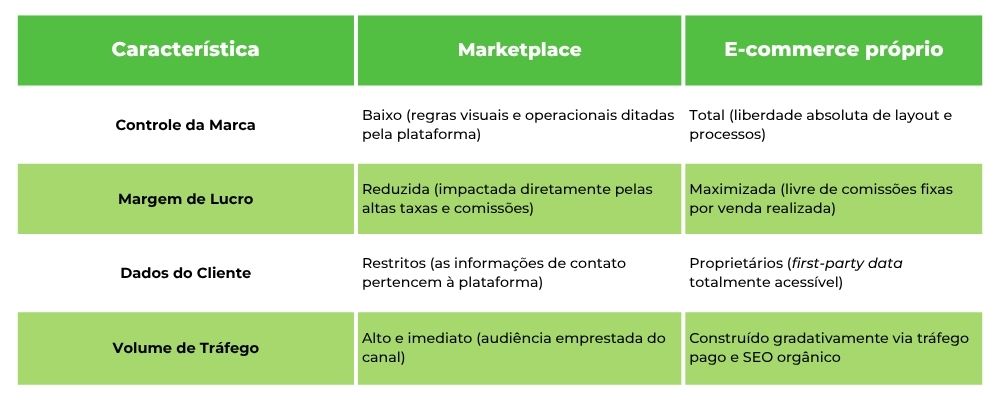
Marketplace vs. Own E-Commerce
To clarify the structural differences that define the future of a digital operation, we have prepared the table below.
Technology in favor of hybrid and integrated growth.
Today, technology allows your company to avoid choosing just one exclusive path. High-performance platforms natively integrate your own store with the largest online marketplaces in the country . This way, you use third-party channels to distribute your catalog and quickly acquire new customers. Simultaneously, you strengthen your direct sales channel to retain your most valuable customers and increase the overall average order value. This allows your business to scale intelligently.
Therefore, we invite you to explore other content on the e-Plus blog to continue refining your strategy. Now, if your project requires immediate traction and commercial independence, talk to our team of experts . Discover the best solutions for deploying online stores to build your brand's own e-commerce platform with cutting-edge technology and architecture.
FAQ – Frequently Asked Questions about Marketplace
What is a marketplace in e-commerce?
A marketplace is a collaborative sales platform that functions like a large virtual shopping mall. In this way, it allows multiple independent retailers to register and sell their products on a single website, taking advantage of the high volume of organic traffic generated by the brand managing that channel.
Is it still worth selling on third-party platforms in 2026?
Yes, selling through these channels is still worthwhile as an initial audience attraction strategy. They are excellent entry points for beginning retailers. However, brands that truly want to scale should focus on building their own e-commerce platform to ensure sustainable profit margins.
What is the main difference between a marketplace and your own store?
The main difference lies in the control of the operation and the ownership of the data. In a proprietary store, the brand controls the entire customer journey, retains contact information, and, moreover, does not pay sales commissions. On the other hand, in the third-party model, the rules, fees, and customers belong entirely to the platform.