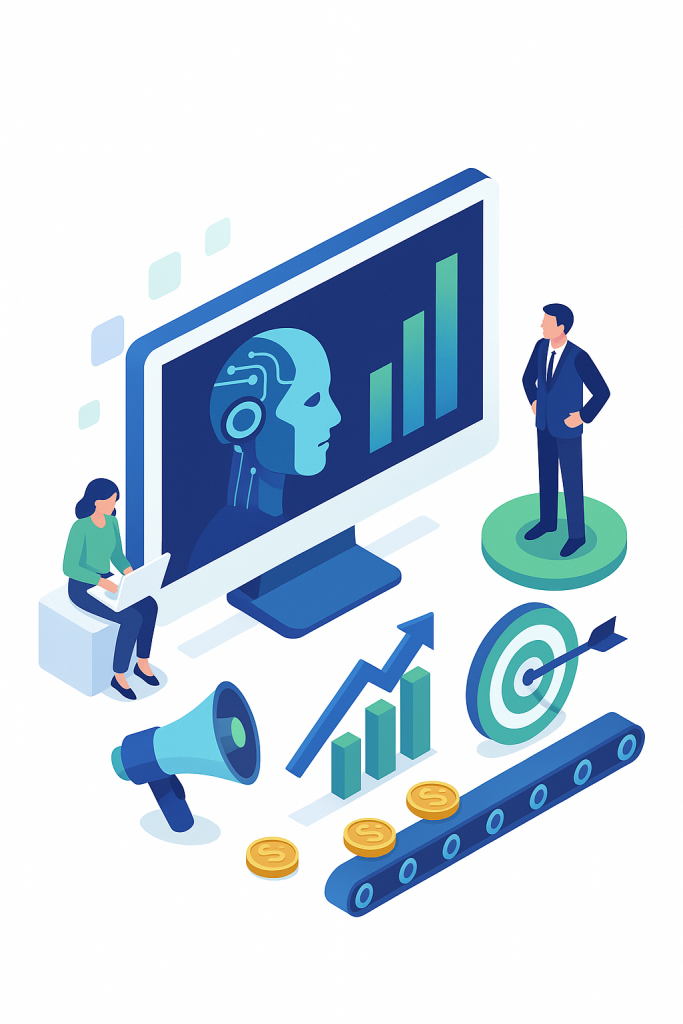
Digital marketing has evolved more in the last five years than in the entire previous decade. What was once manual, based on trial and error, is now driven by data, algorithms, and continuous learning. At the heart of this transformation is Artificial Intelligence, which has become the core of performance marketing strategies.
It not only automates campaigns, but understands patterns, identifies opportunities, optimizes investments, and predicts behavior. The result is simple and powerful: more results with less waste.
In this article, you will understand how AI is revolutionizing performance marketing, what technologies are behind this change, and how to strategically apply this power in your company.
The new performance marketing
Performance marketing is any action aimed at generating measurable results, such as leads, sales, or engagement. But in recent years, it has become more complex.
Consumers interact with brands across multiple channels: social media, email, search engines, websites, marketplaces, and even virtual assistants. Managing all of this manually is impractical.
It is in this scenario that Artificial Intelligence becomes indispensable. It acts as a brain that analyzes data in real time, learns from the results, and makes automatic decisions to improve campaign performance.
With AI, marketing is shifting from reactive to adaptive . Instead of waiting for results to act, companies are adjusting their strategies as the campaign unfolds.
How AI empowers performance marketing.
Artificial intelligence impacts all stages of performance marketing: analysis, planning, execution, and optimization. See how this happens in practice.
Analysis and understanding of the audience.
AI analyzes millions of interactions to identify patterns in behavior, preferences, and purchase intentions. It can discover, for example, that a certain audience responds better to campaigns in the late afternoon or that a particular age group tends to click more on short videos than on static banners.
With these insights, marketing becomes much more effective, reducing media waste and increasing return on investment.
Data-driven planning
Instead of defining strategies based on assumptions, AI uses historical data and predictions to suggest the best combinations of channels, times, creatives, and messages.
It also helps to simulate scenarios, showing how small changes can impact the final result. It's like having a marketing lab that's always running, continuously learning.
Automatic campaign optimization
One of the most powerful applications of AI is real-time optimization. Algorithms adjust bids, redistribute budget, pause underperforming ads, and boost those that are generating conversions.
The result is continuous efficiency. Every minute, the AI learns from the data and automatically adjusts campaigns, something that would be impossible for a human team to do with the same speed and precision.
Dynamic and personalized creation
AI also helps in the creation of advertising pieces. Based on behavior and context, it generates variations of ads adapted for different audiences, times, and platforms.
This allows for highly personalized campaigns, with language and aesthetics automatically adjusted for each audience segment. And the more relevant the communication, the higher the conversion rate.
Intelligent attribution and measurement
One of the biggest challenges in performance marketing is understanding which channel actually generates results . AI solves this problem with attribution models based on machine learning.
She analyzes the entire user journey, from the first click to conversion, and identifies which touchpoints were decisive. With this information, the manager can then invest in what truly works, not just what appears to work.
Practical examples of AI in performance marketing.
E-commerce
An online store implemented AI to manage paid media campaigns based on customer behavior and inventory data. Ads were then automatically updated according to product availability and demand. The result: a 25% increase in ROAS and a 30% reduction in cost per acquisition.
B2B Services
A technology company used AI to identify leads most likely to convert based on previous interactions and demographics. The sales team was able to prioritize the right contacts and reduced the sales cycle time by 40%.
Education
An educational institution used AI to personalize ads and emails based on students' level of interest. The enrollment conversion rate increased by 18%, and digital engagement nearly doubled.
These examples show that AI is much more than automation. It is a tool of precision and intelligence applied to results.
How to combine data, media, and creativity with AI.
The true strength of AI-powered performance marketing lies in the integration between data, media and creativity.
When aligned, these three pillars generate more human and efficient campaigns.
- DataThey feed the system and allow us to understand the behavior of the public.
- MediaThis is where the intelligence comes into play, adjusting bids, segmentations, and budgets.
- CreativityIt transforms analysis into emotion, delivering messages that connect.
AI ensures that all three work harmoniously. It indicates which message should be shown, to whom, and at the most opportune moment.
This integration is what we call intelligent marketing orchestration.
The importance of the strategic vision
Despite all the automation, AI-powered performance marketing requires a clear strategic vision. It's not enough to use sophisticated tools; you need to define concrete business goals.
The first step is to connect marketing metrics to the company's objectives. For example, if the objective is to increase profit, it's not enough to just generate clicks. It's necessary to generate customers with high lifetime value (LTV) and low customer acquisition cost (CAC).
AI helps balance these variables and optimize long-term investment. But it's human insight that defines what truly matters.
How to implement AI in performance marketing
Implementation can begin gradually.
Here's a practical guide:
- Map the available data.
Identify all sources of information: Google Ads, Meta Ads, CRM, Analytics, e-commerce, and automation platforms. - Define key performance indicators (KPIs).
Choose metrics that truly impact the business, such as ROI, ROAS, CPL, and LTV. - Integrate tools and platforms
Use APIs and integration systems so that AI can analyze everything together. - Test and learn continuously.
AI improves over time. Run automated A/B tests and analyze the learnings. - Empower the team
Invest in internal knowledge. The more the team understands AI, the better they use the tools. - Monitor and optimize
Track AI reports and insights. Adjust campaigns, refine creatives, and constantly improve.
With this structure, AI becomes a natural extension of the marketing strategy.
The balance between technology and purpose.
AI brings efficiency, but it's the human perspective that brings purpose. The success of performance marketing depends not only on automation, but on the ability to tell good stories, generate value, and connect emotionally with the audience.
Technology is the engine, but purpose is the fuel. Companies that understand this relationship create more human, relevant, and sustainable campaigns.
The future of performance marketing with AI.
In the coming years, we will see even greater progress. Generative AI will be able to create complete ads in real time, adjusting images, text, and offers according to each user's context. Algorithms will also better understand the intent behind searches and conversations, delivering more personalized results.
Furthermore, AI-based virtual assistants will become new acquisition channels. Companies that are prepared to be found through these platforms will have a huge competitive advantage.
The performance marketing of the future will be autonomous, dynamic, and driven by real-time behavioral data . But it will still need strategic and creative professionals to set the right course.
Conclusion
Artificial intelligence is transforming performance marketing into a living, intelligent system. It learns, adapts, and continuously improves, helping companies achieve previously unimaginable results.
The secret lies in integrating data, automation, and creativity with purpose. When AI is used strategically, marketing ceases to be a cost and becomes an investment with a predictable return.
The future belongs to brands that know how to combine technology and sensitivity. And that future has already begun.
Quick FAQ
1. Does AI replace human work in marketing?
No. It automates processes and analyzes data, but strategy and creativity remain human.
2. How long does it take to see results with AI in performance?
Between 30 and 90 days, depending on the complexity of the campaigns and the quality of the data.
3. Is a lot of investment required?
Not necessarily. There are affordable and scalable solutions for companies of different sizes.
4. Which channels benefit the most?
Google Ads, Meta Ads, email marketing, CRM, and media automation are the main ones.
5. Does AI improve campaign personalization?
Yes. It allows you to create personalized ads and messages at scale, based on behavior and context.
Want to scale your results with Artificial Intelligence? e-Plus helps your company to... Implementing AI in performance marketing to increase conversion and optimize investment..
Chat with e-Plus and discover how to take your campaigns to the next level.