
Intelligent data collection has become the main driver of growth in the contemporary digital market. According to recent research from the Boston Consulting Group (BCG) , companies that fully integrate their proprietary data sources can double their incremental revenue per ad. Furthermore, these companies improve cost efficiency by 1,5 times (or 150%) compared to less integrated operations.
Given this scenario of high profitability and new global privacy regulations, first -party data has ceased to be merely an inert contact list and has become a brand's most valuable corporate asset . Consequently, managers who do not use this information in a structured way lose competitiveness daily. Therefore, understanding how to capture, organize, and activate this immense volume of data is the fundamental step to scaling sales and dominating your niche.
WHAT YOU NEED TO KNOW ABOUT FIRST-PARTY DATA
- What is it: o first-party data (or first-party/proprietary data) encompasses any and all information that your company collects directly from the consumer, with their consent, through its own channels;
- Funding sources: This valuable data is generated by the purchase history on the website, browsing behavior on the pages, responses to forms, and interactions in the CRM;
- Privacy and security: Since the user provides this information voluntarily, the model ensures full compliance with data protection laws (such as the LGPDThus, the strategy eliminates the legal risk to the brand;
- Absolute precision: Unlike databases purchased from third parties, proprietary data offers an accurate, clean, and reliable picture of who actually searches and buys from your online store;
- Advanced customization: With this detailed collection of information at hand, the company can precisely segment paid traffic campaigns, rapidly increasing its conversion rate.
- Financial autonomy: The intelligent use of this asset reduces the constant dependence on external algorithms. Therefore, e-commerce consistently lowers its cost of acquisition per channel.
The Evolution of Analysis and the Challenge of Idleness
In our experience implementing digital marketing and inbound marketing strategies at e-Plus , we've observed that idle information is the biggest money drain in digital retail. Online stores frequently accumulate thousands of emails, category preferences, and abandoned cart histories daily . However, the vast majority fail to process this data to understand the consumer's context. Without clear analytical analysis, the company continues to spend paid media budgets to reach customers who were already ready to buy organically.
A common challenge in technical expansion projects is precisely connecting these loose ends. After all, capturing data is only the first step in the business intelligence process . To transform isolated numbers into real revenue, the retailer needs to cross-reference browsing history with inbound marketing tools . In this way, the brand creates hyper-personalized automation flows that directly address the visitor's pain points and desires.
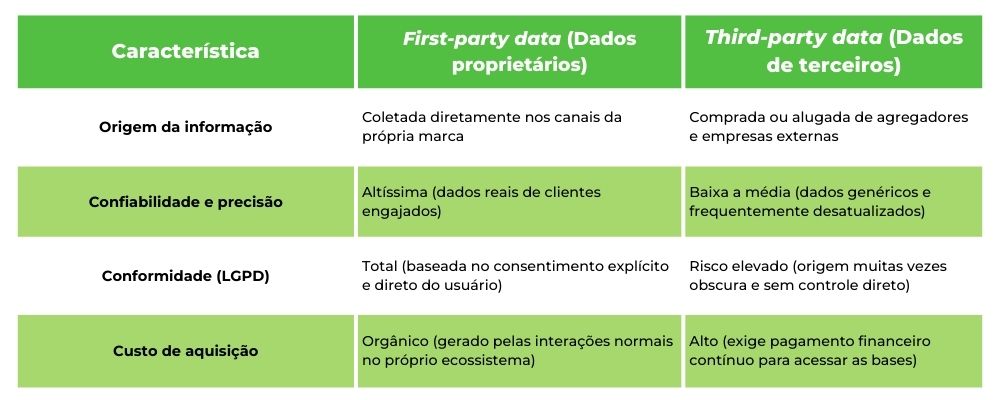
FIRST-PARTY DATA VS. THIRD-PARTY DATA (THIRD-PARTY DATA)
To clarify the urgency of this strategic transition, we have prepared the table below. It highlights why data exclusivity dominates the current competitive landscape.
How Data Analysis Boosts CRO and Retention
True business transformation happens when we activate this information in the areas of conversion rate optimization (CRO) and performance analysis . Initially, understanding your client owner's heatmaps and clicks helps reshape the usability of the entire website. If the data shows that a loyal segment abandons the page precisely at the shipping cost calculation, you can test exclusive delivery offers for that group . As a practical result, friction disappears and conversion skyrockets without the need to inflate the advertising budget.
Furthermore, customer retention reaches a new level of excellence. Brands that intensively use proprietary data can predict the exact time of repurchase of a recurring product. Therefore, the system sends a replenishment email the moment the customer's item is running low at home. This proactive approach raises the brand's Net Promoter Score (NPS) and dramatically improves the overall return on ad spend (ROAS) of the operation.
The future of digital retail belongs to owned data.
In short, the era of generic advertising based on intercepted cookies has come to an end. On the other hand, companies that structure their own intelligence databases will lead the retail market by a wide margin. Proprietary data is the only asset that your competition cannot copy, hack, or buy. Therefore, investing in the organization and activation of this internal treasure is the most profitable business decision today.
Therefore, we invite you to explore other content on the e-Plus blog to continue refining your business strategy. Now, if your project requires immediate traction and competitive intelligence, talk to our team of experts . e-Plus masters the structuring of Digital Marketing, advanced Data Analysis and CRO strategies, ensuring that your e-commerce transforms each interaction into a valuable, high-converting asset.
FAQ – Frequently Asked Questions About FIRST-PARTY DATA (PRIMARY DATA)
What is first-party Data in e-commerce?
First -party data is the set of information, history, and behaviors that e-commerce businesses collect directly from their own visitors and customers. This data collection occurs natively through the website, app, or CRM of the store, always requiring the transparent and legal consent of the consumer.
Why is proprietary data so vital now?
Proprietary data is vital now due to the strictness of new privacy laws and the global blocking of third-party trackers. It ensures your company can continue targeting offers and analyzing performance metrics with complete accuracy, without being held hostage by the restrictive rules of other large platforms.
How CRO and data analytics utilize the first-party data?
Data analysis and CRO utilize first-party data to identify real bottlenecks in your online store's navigation. By understanding the behavior of your primary audience in detail, specialists test variations on the pages, facilitate the checkout process, and personalize storefronts, significantly increasing sales volume.