

If your business doubled its sales volume tomorrow, would your current technology be the engine of that growth or the barrier? According to projections from the Brazilian Association of Electronic Commerce ( ABComm ) , digital retail in Brazil should generate between R$ 235 billion and R$ 248 billion in revenue by 2026. To capture this demand, e-commerce platforms are now true complex ecosystems of data, payments, and integrations.
Deciding to change technology or evolve the current one requires evaluating not only the immediate implementation cost, but also the store's ability to adapt to new consumer behaviors and market innovations. The transition needs to be based on software architecture, server scalability, and real-world performance during critical access times.
In this article you will read:
Essential decisions in digital commerce
- What is a platform? SaaS? It's a software-as-a-service model where the infrastructure, security, and hosting are maintained by the technology provider. This allows the retailer to focus on sales and marketing operations without having to manage their own servers.
- When should you plan a migration? Technology replacement becomes unavoidable when the current system exhibits chronic instability during peak traffic periods, limits connections with modern market tools, or generates a Total Cost of Ownership (TCO) disproportionate to revenue.
- What is Composable Commerce? This is an architecture based on modular components. Different independent solutions (search engine, payment gateway, shopping cart management) are connected via APIs to build a highly customizable system.
- Like architecture Headless act? The Headless decouples the front-end (the visual interface of the store) of Back-end (the business rules engine and database). This separation ensures faster loading speeds and complete design flexibility.
- Why does TCO dictate project longevity? Total Cost of Ownership assesses not only the monthly fee or commission for the tool, but also projects costs for developers, evolutionary maintenance, version updates, and third-party application subscriptions over the years.
The architectural transition: from monolithic to structural flexibility.
The evolution of e-commerce platforms reflects the corporate need for speed of adaptation. In the past, monolithic architecture systems dominated the market and, consequently, hampered operations. A simple change in the checkout page layout or storefront structure required direct intervention in the central code, increasing the risk of system instability and demanding weeks of technical work.
Currently, international technology trend reports, such as Gartner's Hype Cycle for Digital Commerce 2026, classify modular and composable architectures as solutions with transformational benefits for retail. This structural separation reduces the technical debt accumulated over years of complex integrations and stopgap customizations.
With flexible foundations, online stores can keep up with operational innovations in real time. Emerging solutions based on artificial intelligence, such as Agentic Commerce, are gaining traction and viability precisely because modern infrastructure allows for the addition of new features without the need to rewrite the store's core code.
The importance of SaaS technology at the retail scale.
SaaS solutions continue to dominate replatforming decisions because they deliver very high operational predictability. Governance over system updates, protection against seasonal cyberattacks, and automatic scalability of the server infrastructure are entirely the responsibility of the software provider.
For e-commerce management, this means redirecting the budget previously spent on heavy IT infrastructure to optimizing conversion rates, personalizing the user experience, and aggressive traffic acquisition strategies.
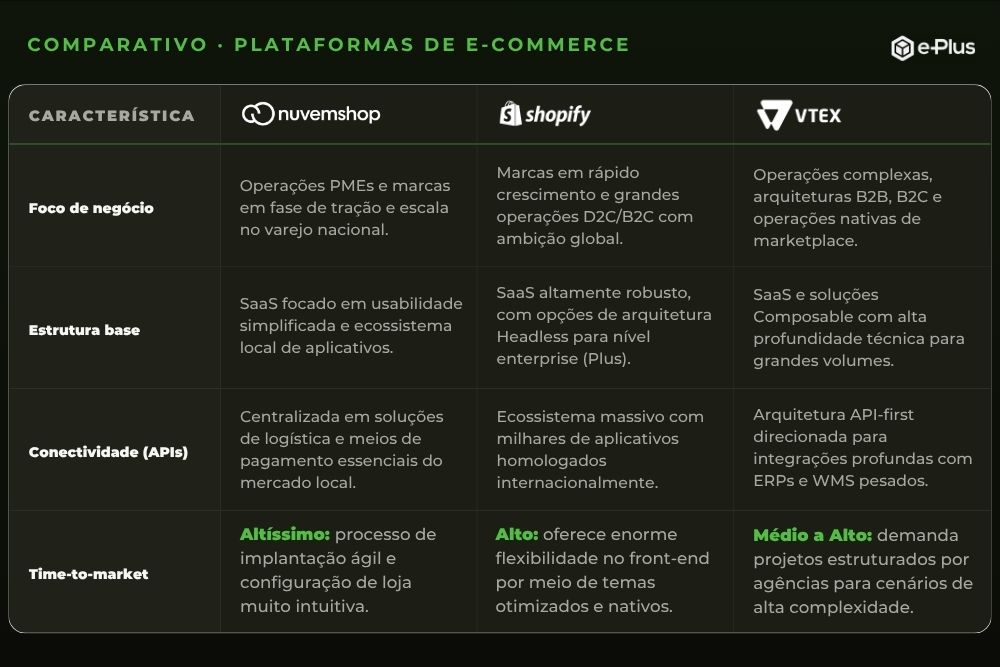
Comparison of e-commerce platforms
Choosing between the leading technologies on the market requires considering the company's maturity level against the native capabilities of each system. Directly evaluating industry leaders facilitates understanding where each ecosystem delivers the greatest technical return.
Engineering KPIs: Monitoring Health Beyond Revenue
Investment decisions in e-commerce platforms are often approved based on projections of increased ROAS (Return on Ad Spend) or average order value. However, sustaining sales performance requires constant monitoring of metrics strictly linked to the digital infrastructure.
API response time (latency)
Modern systems thrive on data requests in fractions of a second. The exact time it takes for a store's checkout process to look up shipping times in the logistics system or to authenticate a transaction with the payment gateway directly impacts the consumer . Slow responses accumulate navigation friction and drive up shopping cart abandonment rates.
Uptime and real stability under stress.
Maintaining 99% uptime might sound acceptable in a superficial report, but mathematically it represents almost four full days of store downtime in a business year. What truly defines the robustness of an ecosystem is its resilience: the ability of the elastic infrastructure to absorb sudden spikes in simultaneous access during Black Friday without showing any degradation in page loading times.
Time-to-market for new technical features
How many days does the development team need to deploy a new discount mechanism or change the layout of elements on a campaign landing page ? Rigid architectures delay the launch of marketing campaigns . A lean time-to-market reflects an organized and modular code environment.
B2B demands and the autonomous advancement of Artificial Intelligence.
The functional separation between platforms geared towards end consumers (B2C) and corporate clients (B2B) is rapidly disappearing. The modern wholesale buyer demands the same fluid navigation as traditional retail, but with heavy layers of logic behind the screen . Serving corporate operations requires platforms to process purchase approvals at multiple levels, render catalogs segmented by billing region, and apply dynamic tax rules directly to the shopping cart.
Simultaneously, the architecture of e-commerce platforms needs to be ready for the consolidation of Artificial Intelligence in autonomous transactions. Market analyses and Gartner projections for 2026 solidify the scenario of Agentic Buying , in which artificial intelligence systems will execute price research, quotation, and purchasing processes on behalf of companies and individuals.
Stores operating on closed infrastructures will encounter immense technical barriers to communicating their inventory with these AI agents. Only open ecosystems, supported by modern APIs and consistent documentation, will be able to interact with these new autonomous interfaces without requiring a complete redesign of the database with each technological update.
The maturity of a digital channel doesn't lie in how many functions the platform natively possesses today, but in its structural ability to incorporate the innovations that will dominate the market in the coming months.
If your store's structure is limiting your business scalability or consuming a disproportionate share of your revenue with endless maintenance, anticipating a strategic transition will make all the difference in the long run. Continue exploring the content on the e-Plus blog . If it's time to evolve your project, our team of experts is ready to guide you through sustainable implementation and migration processes in systems like VTEX, Shopify, and Nuvemshop.
FAQ – Frequently Asked Questions about E-Commerce Platforms
What defines scalability in an e-commerce environment?
Scalability is the systemic capacity of a technology to absorb an exponential increase in access, simultaneous transactions, and data processing without experiencing server crashes or slowdowns, thus sustaining sales conversion during high-traffic campaigns.
What signs indicate the exact technical moment to switch platforms?
Technological transition is indicated when the existing system begins to demand excessive temporary customizations (workarounds), inflates costs with legacy code maintenance, and makes it impossible to quickly connect with new logistics solutions or payment ecosystems.
How does the headless model differ from a monolithic online store?
In a monolithic system, the visual interface and the database are coupled into a single, dense block of code. The headless model definitively separates these two structural layers, freeing the development team to innovate the visual experience without jeopardizing security and back-office operations.


