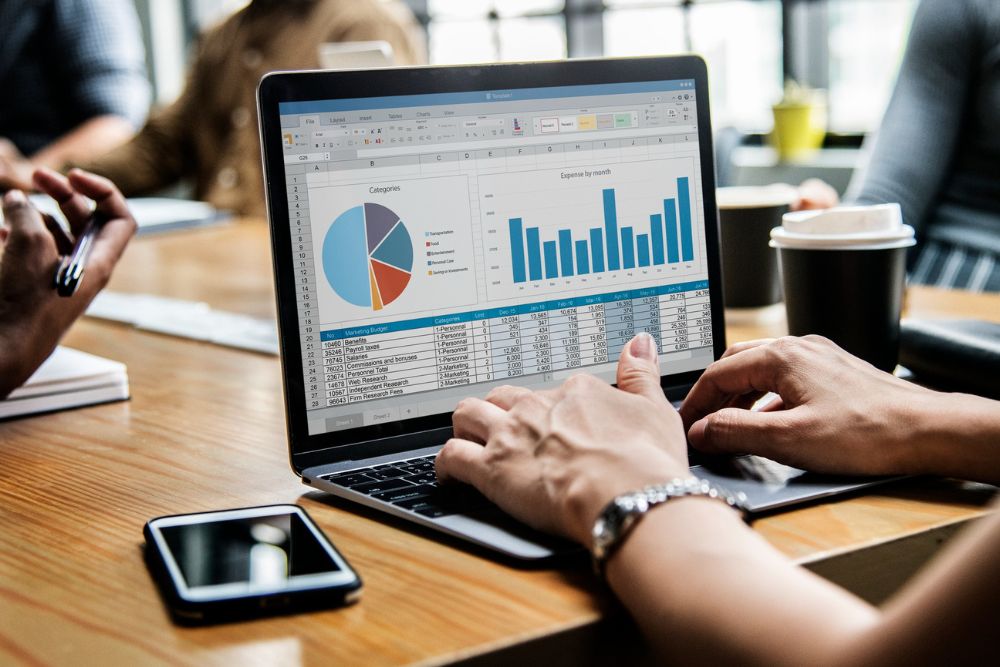
In a saturated digital market, the margin for operational errors is practically nonexistent. Currently, insisting on decisions based solely on disconnected spreadsheets is a sure path to loss. Conversely, the combination of data, predictability, and AI has ceased to be a competitive advantage and has become an indispensable condition for a company's sustainability in today's market.
Unfortunately, many managers still operate in the dark. That is, they invest marketing funds without certainty of return , buy inventory based on "sentiment," and ignore the clear signs of churn (cancellation) that the customer base emits. Consequently, the Customer Acquisition Cost (CAC) skyrockets, inventory accumulates, and the profitability of the business is silently eroded by inefficiency.
However, technology offers a solution to this problem. The correct implementation of artificial intelligence applied to data analysis allows for the accurate anticipation of scenarios . Therefore, in this article, we analyze how to abandon guesswork and adopt a data-driven culture to protect your cash flow and scale safely.
What you need to know about data, predictability, and AI.
- The concept: use of Artificial Intelligence to process large volumes of data and predict behavioral and sales trends.
- The benefit: Drastic reduction of financial risks and inventory optimization.
- The application: From personalized product recommendations to automatic bid adjustments in paid media.
- B2B and B2C: essential for predicting Buyback in B2B and avoid abandoned shopping cart in B2C.
- ROI: It increases the Return on Investment by directing funds only to where there is a real probability of conversion.
FROM DESCRIPTIVE TO PREDICTIVE ANALYSIS
First, it's essential to understand the evolution of data maturity. Before, we looked at what happened. Now, with data, predictability, and AI, we look at what will happen.
For example, modern Business Intelligence (BI) tools integrated with AI don't just report that sales have fallen. On the contrary, they cross-reference external variables (such as weather, economy, and seasonality) to warn that demand for a particular SKU will fall in the coming week.
Customization as a CAC reducer
Furthermore, predictability directly impacts media efficiency. Generally, sending generic emails to the entire database has a low cost but poor conversion rates.
On the other hand, machine learning algorithms can identify which customers are likely to buy in the next 24 hours. Therefore, we concentrate our advertising budget only on these users. The result? A significant increase in LTV (Lifetime Value) and a real decrease in the cost to generate each sale.
TERMS YOU NEED TO UNDERSTAND
To lead the data transformation in your company, master the global terms:
| THERMO | MEANING |
| Predictive analytics | Predictive analytics. The use of data, statistical algorithms, and machine learning techniques to identify the probability of future outcomes. |
| Data-driven | Data-driven. A culture where strategic decisions are made based on data analysis and interpretation, not intuition. |
| Forecasting | Forecasting. The process of estimating future sales or demand. |
DATA STRATEGY AND PARTNER ECOSYSTEM
Above all, having data doesn't mean having intelligence . Often, companies possess terabytes of information that don't generate value because the systems don't communicate with each other. e-Plus's role is to design the strategy that transforms this data into revenue.
While the technical integration between ERP and platform is an internal responsibility of your company, we handle the implementation of the online store and the application of AI solutions . Our expertise ensures that the store's infrastructure is ready to receive and process this data efficiently.
To ensure success, we recommend certified and reliable partners to execute complex back-office integrations . This guarantees the ecosystem functions smoothly: the partner connects the wires, and e-Plus applies marketing intelligence and technology to analyze the data and generate actionable insights, such as stockout alerts or CRM opportunities.
CONCLUSION: PRECISION IS PROFITABLE
Finally, it is clear that by 2026, data, predictability, and AI will be the cornerstones of professional management that prioritizes financial sustainability . Those who ignore data science are doomed to pay more for each client and lose competitiveness to more agile operations.
Therefore, the invitation is to professionalize your vision. Let the computer handle the complex calculations and free your team to focus on creative strategy and relationship building. e-Plus combines technological expertise with business acumen to make this transition happen in your company.
Do you want to transform your data into a machine of predictability and profit?
[Talk to the e-Plus experts and find out where your operation is losing money.]
FAQ – Frequently Asked Questions about Data, Predictability, and AI
What is the difference between data analytics and predictive AI?
Essentially, traditional data analysis examines the past to explain what happened. Predictive AI, on the other hand, uses this historical data to project the future, anticipating trends and consumer behavior.
How to implement predictability in e-commerce?
First, it's necessary to centralize the data by integrating the platform, ERP, and marketing tools. Then, AI algorithms are applied to process this information. Hiring a specialized consulting firm accelerates this process.
How much does it cost to use AI for sales forecasting?
It depends on the volume of data and the tools chosen. However, the cost of the tool is usually quickly recouped through savings generated by optimizing inventory and reducing wasted media spending.
Does AI replace the marketing manager?
No. AI processes the data and suggests likely paths with superhuman speed. However, the final decision regarding strategy, brand voice, and customer relationships remains human.