In an increasingly competitive market, customer experience has gone from being just a differentiator to becoming central to business strategies. How a customer is served, guided, and delighted determines whether they will return to buy again or switch to a competitor.
And this is where Artificial Intelligence becomes one of the most powerful tools of the century. More than just automating tasks, AI allows us to understand consumer behavior in depth, predict needs, and offer truly personalized experiences.
In this article, you will understand how to apply Artificial Intelligence to transform the customer journey, increase satisfaction, and build lasting relationships based on data and intelligence.
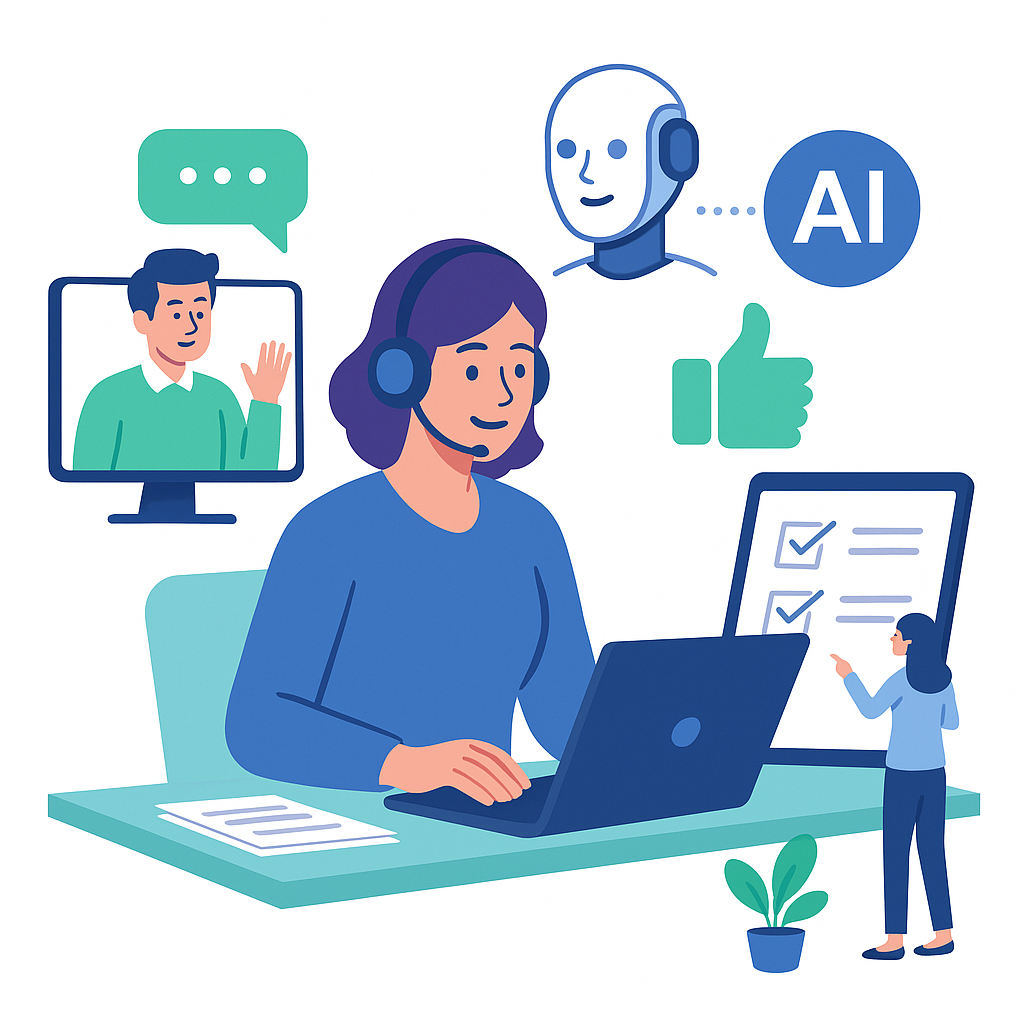
The new consumer profile and the role of AI.
Today's consumer is impatient, connected, and extremely demanding. They expect quick answers, seamless experiences, and personalized communication. They want to be served through their preferred channel, at their preferred time, with the same quality across all touchpoints.
Meeting this standard manually is virtually impossible. AI emerges to fill this gap, offering speed, consistency, and intelligence in every interaction.
It learns from the customer's behavioral history, recognizes patterns, and anticipates needs. In other words, it transforms data into scalable empathy. Companies that master this practice not only build customer loyalty but also create brand advocates.
The impact of Artificial Intelligence on the customer journey.
The customer journey consists of several stages: discovery, consideration, decision, purchase, and post-sale. AI can act in all of them, in different ways, to make the experience more fluid and enjoyable.
Discovery
At this stage, the customer is still getting to know the brand. AI helps identify who these potential consumers are, understand their interests, and display the right content at the right time.
For example, an algorithm can analyze browsing behavior and display personalized ads based on visited pages, previous searches, and consumption patterns. This increases the chance of engagement and creates a positive first impression.
Consideration
When customers are evaluating options, AI helps provide relevant information. It can suggest similar products, highlight differentiating features, and even anticipate questions before they arise.
The use of intelligent chatbots and virtual assistants at this stage is crucial. They offer 24/7 support and help reduce decision-making time.
Decision
Here, Artificial Intelligence works to eliminate friction and facilitate the purchase. It can dynamically adjust prices, suggest personalized offers, and simplify checkout based on purchasing behavior.
AI also analyzes in real time which actions increase the likelihood of conversion, optimizing the journey for each profile.
After sales
The relationship doesn't end when the sale is completed. It's in the after-sales phase that loyalty truly happens.
AI allows you to monitor customer satisfaction, predict cancellations, and identify upsell or cross-sell opportunities. For example, if the system detects that a customer is not using a contracted service, it can suggest new ways to use it or additional benefits.
This type of care creates an emotional connection and transforms a transaction into a relationship.
The practical benefits of AI in customer experience.
Companies that strategically apply AI see rapid and measurable gains. Key benefits include:
- Faster and more efficient service
Chatbots and virtual assistants reduce queues, resolve simple queries, and free up human staff for complex tasks. - Real-time personalization
AI analyzes each customer's behavior and automatically adjusts messages, offers, and recommendations. - Behavior prediction
Based on historical data, AI anticipates needs, identifies cancellation risks, and suggests preventative actions. - Reduction of operating costs
Automating parts of customer service and communication reduces costs without sacrificing quality. - Increased satisfaction and loyalty
The experience becomes more fluid, enjoyable, and relevant, increasing the likelihood of repurchase.
These results show that AI is not just a tool for efficiency, but a strategy for delighting users.
Real-world examples of AI applied to customer experience.
E-commerce
An online store used AI to analyze purchasing behavior and create personalized storefronts for each visitor. The result was a 28% increase in conversion rate and a 15% increase in average order value.
Financial services
A digital bank implemented AI to predict when customers were about to cancel services. This allowed them to act proactively, offering personalized alternatives and benefits. Churn fell by 20% in three months.
B2B Industry
A technology company used AI to identify patterns of dissatisfaction in support messages and prioritize critical service requests. This reduced the average response time and increased the NPS by 18 points.
These cases show that AI improves the experience broadly, combining agility, predictability, and individual care.
How to start using AI to improve customer relationships.
Applying Artificial Intelligence to the customer journey may seem complex, but it's possible to start in a structured way. Here's a practical path to take the first steps:
1. Map the points of contact.
Identify all the channels through which your brand interacts with the customer: website, social media, email, WhatsApp, physical store, customer service. AI only generates good results when there is a complete view of the customer journey.
2. Gather and unify data.
Integrate data from CRM, customer service, purchase history, and digital behavior. With centralized information, AI can understand the customer as a whole and offer more accurate responses.
3. Choose a starting point.
Start with a process that generates quick impact, such as automated customer service, product recommendations, or satisfaction monitoring. Initial results help engage the team and justify further investment.
4. Use AI to learn from the customer.
The more AI interacts, the more it learns. It identifies patterns, discovers preferences, and automatically adjusts the tone of its communication.
5. Monitor results and optimize.
Track metrics such as response time, satisfaction, repurchase rate, and NPS. These indicators show where the experience can be continuously improved.
The balance between automation and humanization.
One of the biggest challenges when using AI in customer service is finding the right balance between technology and empathy. The customer wants speed, but also wants to feel heard.
Therefore, the secret lies in combining the best of both worlds: AI to quickly solve the basics and human beings to solve what requires sensitivity.
Companies that achieve this balance offer more complete and memorable experiences. Technology doesn't replace human contact, but it makes it more efficient and meaningful.
The importance of trust and transparency.
Personalization and automation are powerful actions, but they only work if the customer trusts the brand. And trust is born from transparency.
Explain how the data is used, respect user privacy, and comply with the LGPD (Brazilian General Data Protection Law). Customers who perceive responsibility in the use of technology tend to be more loyal.
Trust is the new engine of digital loyalty.
AI and loyalty: the next frontier
With Artificial Intelligence, building customer loyalty goes beyond points or discount programs. Now it's possible to create relationships based on continuous relevance.
AI understands the customer's life stage, what they need, and how they prefer to be approached.
This makes each interaction feel tailor-made.
When customers feel that the brand truly understands them, they stop comparing prices and start valuing the experience. And that's when customer loyalty happens naturally.
The role of e-Plus in this scenario
e-Plus has helped companies in various sectors implement Artificial Intelligence strategies focused on customer experience. From diagnosing touchpoints to automating and personalizing communications, each project is designed to generate real results.
We combine technology, data analytics, and strategy to create more human and intelligent journeys. Our goal is simple: to help brands become closer to and more relevant to their customers.
Conclusion
Improving customer experience with Artificial Intelligence is not just a matter of technology, it's a matter of vision. Companies that see AI as a relationship-building tool, and not just an efficiency tool, build lasting bonds and competitive advantages that are difficult to copy.
AI doesn't replace the human touch. It amplifies it, allowing each customer to be served with empathy, predictability, and precision.
The future of customer loyalty will be driven by intelligence. And the time to start is now.
Quick FAQ
1. How does AI improve the customer experience?
Analyzing data and behaviors to deliver personalized, fast, and relevant communications across all channels.
2. Which areas benefit most from AI in customer service?
E-commerce, customer service, CRM, marketing, and after-sales service are the most impacted.
3. Is it expensive to implement AI for customer service?
No. There are scalable solutions that adapt to companies of different sizes.
4. Can AI replace human customer service?
No. Ideally, AI should complement customer service, taking care of the basics and freeing up people for strategic tasks.
5. How long does it take to see results?
On average, between 45 and 90 days, depending on the complexity of the project and data integration.
Want to transform your customer experience with Artificial Intelligence? e-Plus helps your company to... Implement AI to personalize customer service and increase customer loyalty..
Chat with e-Plus And see how to delight customers with technology and strategy.