Many B2B companies still treat Google Ads and Inbound Marketing as isolated strategies. On one hand, there are those who invest only in paid media, generating leads quickly—but almost always without nurturing and with a low conversion rate into customers. On the other hand, there are those who bet only on Inbound, generating content and automation flows, but with difficulty in generating immediate demand.
The truth is that combining the two strategies creates a predictable and scalable pipeline . Google Ads captures the immediate intent of those already searching for solutions, while Inbound Marketing educates, nurtures, and prepares leads until they are ready to make a decision.
In this article, you will discover:
- How Google Ads and Inbound Marketing complement each other.
- What happens when they work in isolation.
- The ideal architecture to unite the two strategies.
- Key metrics to measure the impact of this integration.
- A mini-case showing practical results.
- FAQ with the most common questions from B2B managers.
Google Ads in B2B: an engine for immediate acquisition
Google Ads is the primary tool for capturing leads in B2B because it connects with people who are already researching solutions.
Main benefits:
- Active demand: the lead already has a clear pain.
- Intent targeting: ads for specific searches like “industrial fleet management software”.
- Accurate measurement: every click and conversion can be tracked.
- Speed: results appear in days, not months.
Limitations when used alone:
- Many leads come in “cold” and don’t receive nurturing.
- Lack of alignment with sales → leads end up forgotten.
- ROI compromised by the lack of a long-term relationship.
Inbound Marketing in B2B: a driver of nurturing and trust
Inbound Marketing organizes the lead journey based on content and automation.
Main benefits:
- Lead education: equips decision-makers with technical information.
- building authority: your company is seen as a reference in the sector.
- Automated nutrition: flows in RD Station Marketing accompany the lead until the decision.
- Ongoing relationship: keeps the brand present during months of negotiation.
Limitations when used alone:
- It takes time to generate initial lead volume.
- Difficulty in generating immediate predictability.
- Dependence on SEO, social media, or organic traffic.
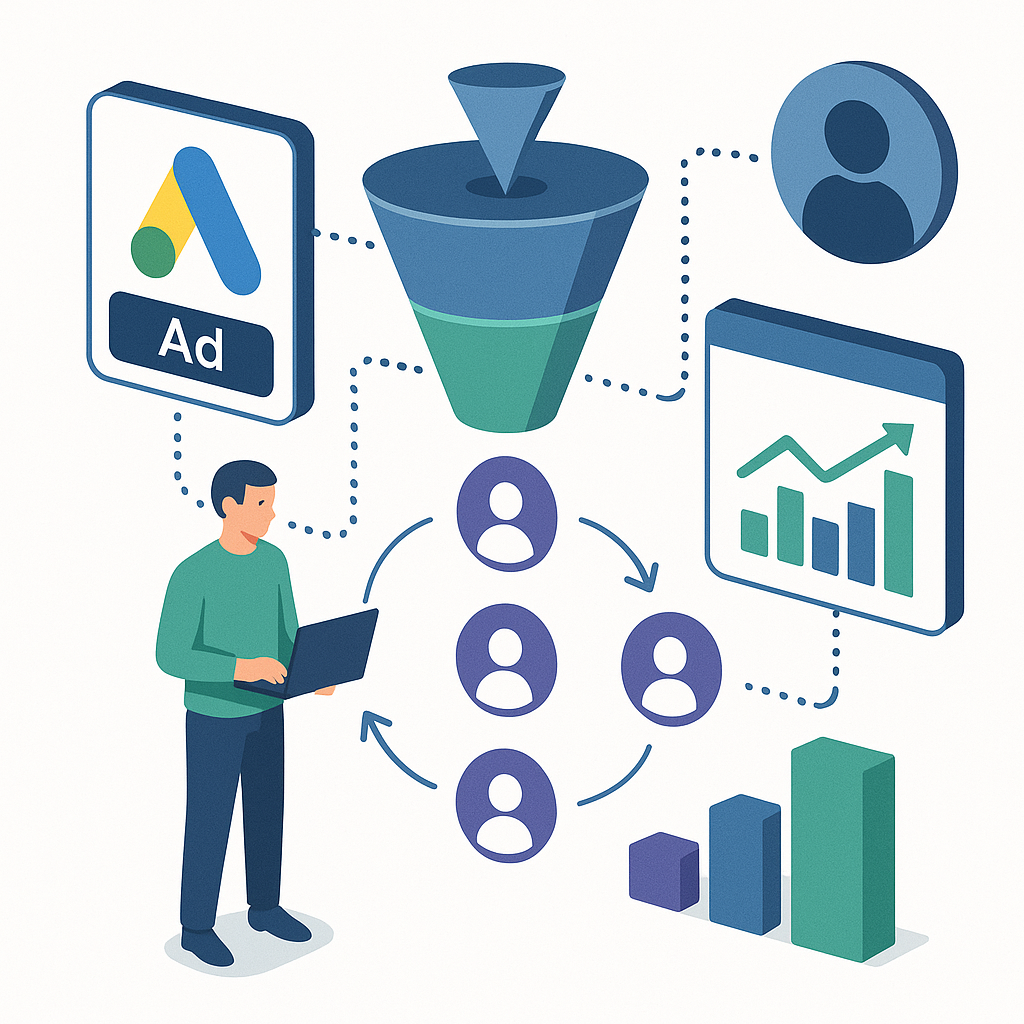
The Power of Integration: Ads + Inbound Working Together
When the two strategies come together, a virtuous cycle is born:
- Google Ads → captures immediate demand.
- Dedicated landing pages → convert visitors into leads.
- RD Station Marketing → organizes, nurtures and scores leads.
- Lead Scoring → separates cold leads from hot ones.
- RD Station CRM → commercial only approaches ready leads.
- Remarketing → maintains relationships with those who are still under consideration.
- Sales feedback → continuously optimizes Ads and Inbound.
Practical Framework: Ads + Inbound Architecture
Step 1 – Capture (Google Ads)
- Long tail search campaigns.
- Product/segment specific LPs.
- Ad extensions (sitelinks, call, snippet).
Step 2 – Conversion (Landing Pages)
- Simple and clear form.
- Value proposition at the top.
- Social proof (clients, cases, certifications).
Step 3 – Nutrition (RD Station Marketing)
- Segmented automated flows.
- Educational content → comparative → social proof.
- Lead Scoring to measure readiness.
Step 4 – Sales (RD Station CRM)
- Pipeline with clear steps.
- Leads only enter the CRM when they reach MQL/SQL.
- Forecast based on closing probability.
Step 5 – Retention/Remarketing
- Ads for those who visited price/product pages.
- Reinforcement content for leads still under consideration.
Key metrics for measuring impact
- CPL (Cost per Lead): how much each captured lead costs.
- CPL-Q (Cost per Qualified Lead): focus on the lead that has fit.
- MQL → SQL conversion rate: how many leads are passed to sales.
- SQL → Customer Conversion Rate: sales team efficiency.
- ROI by channel: Ads + Inbound combined vs. isolated.
Realistic mini-case
An industrial technology company invested solely in Google Ads, generating 500 leads per month—but with little commercial success. After integrating Ads + Inbound:
- Created 5 specific landing pages per product line.
- Implemented segmented nutrition flows in RD Station Marketing.
- Used lead scoring to send only MQLs to the CRM.
- Implemented intent-based remarketing.
Results in 6 months:
- Qualified Leads (MQL) ↑ 190 %
- Opportunities (SQLs) ↑ 150 %
- Average sales cycle ↓ 28 %
- Media ROI ↑ 210 %
FAQ – Frequently Asked Questions
1. Is it worth using Google Ads without Inbound Marketing?
It works, but it limits ROI. Without nurturing, many leads go cold and don't move forward in the funnel.
2. What about Inbound without Ads?
It works in the long run, but demand generation is slower. Ads accelerate initial volume.
3. Which should come first: Ads or Inbound?
In B2B, start with Ads to generate volume and then use Inbound to nurture and convert.
4. Do I need RD Station to integrate Ads + Inbound?
It's not mandatory, but RD Station Marketing and CRM facilitate automation, lead scoring, and predictability.
5. How long does it take to see results with the integration?
The first signs appear within 30 days. Within 90 days, it's possible to clearly measure CPL-Q and SQLs.
6. Is remarketing mandatory in B2B?
Yes, because the cycle is long and the sale rarely happens on the first contact.
7. How can I prove the ROI of this integration to the board?
Set up UTMs, integrate Ads → RD Station Marketing → CRM, and import offline conversions (closures). This shows real revenue by channel.
Conclusion
The most common mistake B2B companies make is relying on Google Ads or Inbound Marketing in isolation. While one generates immediate demand, the other ensures nurturing and relationship building. But it's when they are combined that the pipeline becomes predictable, scalable, and sustainable.
If you want more than just lead generation—if you desire real predictability in your sales funnel—integrating Google Ads + Inbound Marketing is the way to go. Talk to e-Plus now and discover how we can build this architecture to boost your B2B pipeline with predictability and proven ROI.