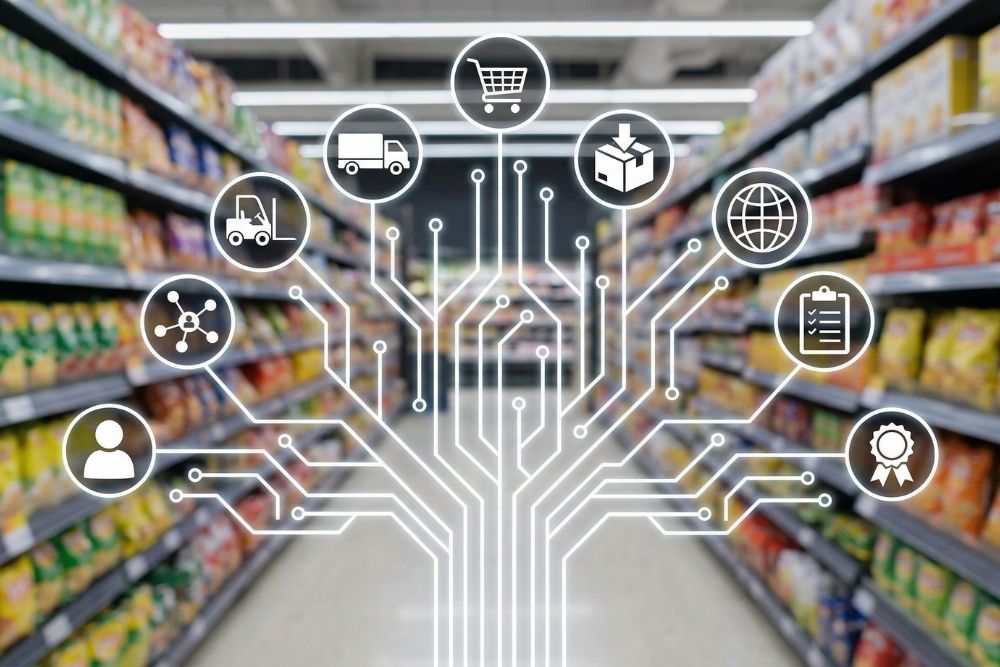
Currently, 45% of consumers prefer to access online stores directly to search for products, bypassing traditional general search engines . This drastic change in browsing behavior has paved the way for a revolution in digital advertising. Retail Media has gone from being a future bet to becoming an indispensable performance driver in retail.
Unlike simply analyzing return on investment (ROI), this strategy requires looking at the entire sales funnel from beginning to end . As a result, advanced metrics, such as conversion rate and return on ad spend (ROAS), reach new levels of efficiency. Therefore, mastering this ecosystem is vital for scaling business results.
What you need to know about retail media.
- What is it: Retail Media is the insertion of brand and industry advertisements directly within the digital spaces of large retailers (e-commerce sites and marketplaces);
- Where it appears: Advertisements typically appear in the site's internal search results, in banners on the homepage, or as suggestions on related product pages.
- Brand perception: The strategy puts the product in the spotlight within the shopping environment, leveraging the consumer's existing trust in the retailer to increase the perceived value of the advertising brand.
- Consideration: By positioning offers alongside competitors at the time of the search, the ad decisively influences and accelerates the user's choice;
- Conversion power: by using the retailer's own actual browsing history (first-party data), the segmentation is extremely precise, which eliminates unqualified clicks;
- Respect for privacy: how segmentation occurs within the closed environment of e-commerce (closed-loopThis practice respects data protection laws and does not rely on third-party cookies.
The impact on brand perception and consideration.
The moment of purchase has changed radically . In our experience implementing paid traffic campaigns at e-Plus, we've observed that the modern user is selective and resistant to interruptions. When a brand appears as a sponsored highlight within industry giants, the consumer transfers the credibility of the store to the product. Consequently, the perceived authority of that brand skyrockets instantly.
Furthermore, consideration gains a strategic boost. In this environment, the user isn't passively scrolling through a social feed. On the contrary, they are actively seeking to fulfill a consumer need . Therefore, impacting this customer with a highly contextualized offer reduces cognitive friction. In this way, the brand shortens the decision journey and captures demand before the competitor can react.
Conversion and the Power of Own Data
The great technical strength of this strategy lies in the use of data. Retailers possess the real transactional history of users . Because of this, campaigns no longer rely on mere demographic assumptions but focus on exact purchasing behavior.
In fact, projections indicate that the Latin American Retail Media market will surpass the US$6 billion mark by 2029. In Brazil, investments in this media format grew by a significant 42% in 2024 alone. These numbers demonstrate the high conversion capacity that retail advertising delivers. A common challenge in digital expansion projects is justifying the cost of acquisition per channel (CAC). However, by advertising within the existing sales ecosystem, the attribution of results is immediate and without loss of tracking.
Traditional Media vs. Retail Media
| Feature | Traditional Digital Media (Social Networks/Search) | Retail Media |
| User moment | Initial information discovery or research | Clear and immediate intention to buy. |
| Basic segmentation | Broad interests and third-party cookies | Actual purchase history (first-party data) |
| Friction until the purchase | Medium to high (requires clicks to load another website) | Very low (purchase occurs within the same environment) |
| Sales assignment | Complex (multiple channels and privacy barriers) | Direct and transparent (closed-loop and ROAS of course) |
Integrating the format with paid traffic strategies.
While retail advertising is highly effective, it doesn't operate in a vacuum. To optimize the time-to-market for new products, operations need an omnichannel approach . This means combining the power of conversion in marketplaces with precise attraction campaigns on Google Ads and Meta Ads . In this way, the company surrounds the consumer at every stage of awareness.
Therefore, scaling sales requires in-depth technical knowledge. Distributing the budget correctly between external attraction and internal conversion is the factor that differentiates market-leading brands. Thus, having professional management ensures that every penny invested generates the maximum possible profitability.
Therefore, we invite you to explore other content on the e-Plus blog to continue refining your strategy. Now, if your project requires immediate traction, talk to our team of experts and discover the best paid traffic solutions to boost your e-commerce ecosystem.
FAQ – Frequently Asked Questions about Retail Media
What is Retail Media?
Retail Media is a digital marketing strategy where brands buy advertising space directly within retailers' websites and apps. This tactic allows them to promote products to consumers who are already in the online store and have a very high intent to complete a purchase.
How does Retail Media operate during the consideration phase?
During the consideration phase, Retail Media works by placing sponsored products in the storefronts and search pages of e-commerce sites. This way, the brand gains visibility at the exact moment the customer is comparing options, influencing the final choice before checkout.
Why does this strategy improve conversion rates?
The strategy improves conversion rates because it uses first-party data from the store itself. Since the system understands exactly what the user typically searches for and buys, it displays highly personalized ads that generate sales with far fewer clicks and less friction.