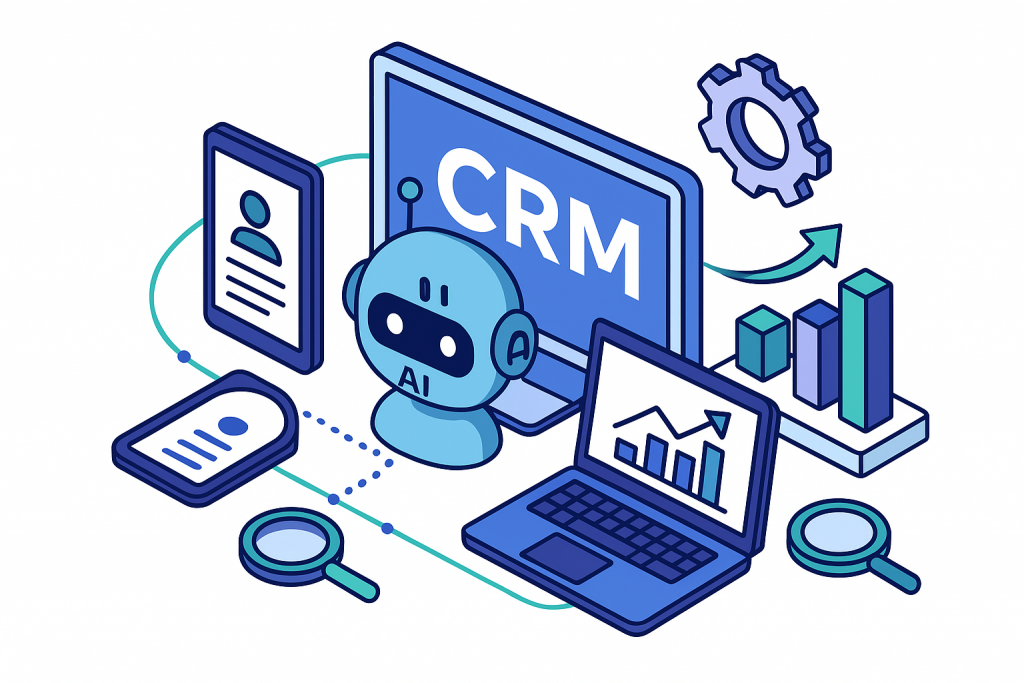
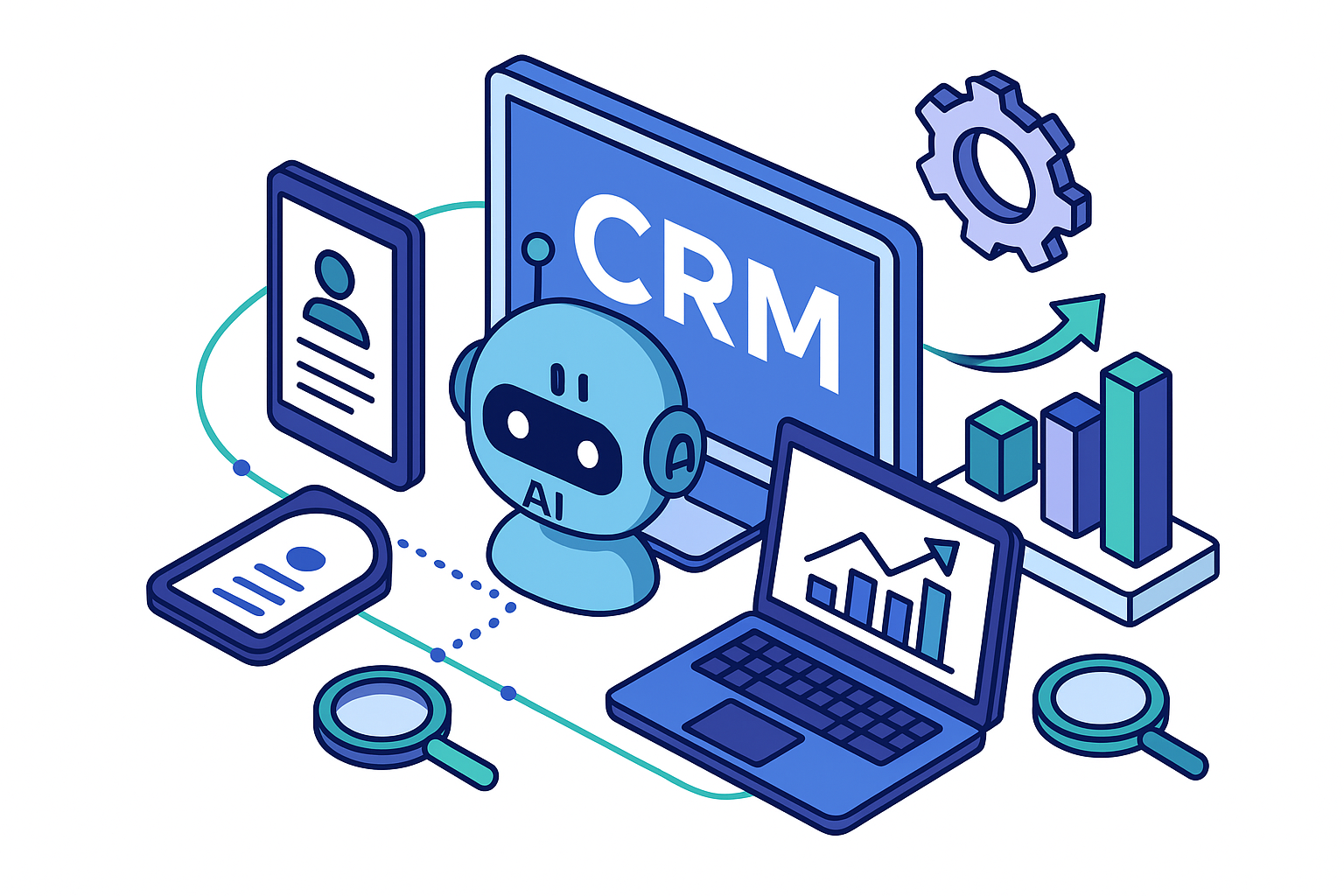
CRMs have always been central to business strategies. They organize information, track opportunities, and help understand customer behavior. But now, with the arrival of Artificial Intelligence, CRM has ceased to be just a record-keeping tool and has become a true engine for growth.
The integration between AI and CRM allows companies to anticipate needs, personalize interactions, increase conversions, and create stronger, more lasting relationships. It's the meeting point between technology and strategy, between data and emotion.
In this article, you will understand how this integration works in practice, what benefits it brings, and how to apply it to transform your sales process.
Why combining AI and CRM is a strategic leap
For years, sales teams have used CRM primarily as an information repository: contact data, interaction history, opportunity status. This information is valuable, but most of the time it remains stagnant, not generating action.
Artificial Intelligence changes this scenario because it transforms CRM into a proactive system . Instead of waiting for the salesperson to analyze data and make decisions, AI automatically analyzes and generates actionable insights, such as:
- Which leads are most likely to make a purchase?
- When is the best time to do a follow-up?
- What type of message is most likely to generate a response?
- Which customers are about to cancel and need attention?
In short, CRM ceases to be a mere record-keeping tool and becomes an intelligent sales assistant.
How Artificial Intelligence Works Within CRM
AI enhances CRM in several ways. See the main practical applications.
1. Predictive sales analysis
Based on historical data, AI can predict which opportunities are most likely to close. It analyzes lead behavior, interaction history, and the sales cycle of similar customers to generate purchase propensity models.
These models help prioritize efforts, saving time and increasing efficiency. The sales team stops working with guesswork and starts focusing on what truly has conversion potential.
2. Automatic action recommendations
AI-powered CRM automatically suggests next steps. For example, if a lead opened an email, visited a pricing page, and remained inactive for two days, the system might recommend immediate contact based on conversion probability.
It can also indicate what content to send, which channel to use, and even the best time to approach customers. It's like having a digital consultant monitoring each salesperson in real time.
3. Intelligent customer segmentation
AI analyzes complex variables such as purchase frequency, average value, engagement, and behavior to create dynamic segmentations . These groups are automatically updated as the data changes.
This allows for much more precise campaigns, increasing open rates, clicks, and conversions. Furthermore, AI helps identify hidden patterns, revealing previously unseen niches or opportunities.
4. Automation and productivity
Repetitive tasks, such as logging interactions, sending follow-up emails, and updating opportunity statuses, become automated. The salesperson gains time to focus on relationship building and negotiation, while the CRM handles the operational work.
This automation reduces errors, increases productivity, and ensures that no leads are lost along the way.
5. Sentiment analysis and quality of interactions
AI can also analyze conversations, emails, and call transcripts to gauge customer tone and sentiment. This allows managers to identify pain points and opportunities for improvement in customer service.
These insights help to refine sales pitches and train teams based on real data, not subjective perceptions.
Real benefits of integrating AI and CRM.
Integrating Artificial Intelligence into CRM brings immediate and sustainable gains. Among the main benefits are:
- Increase in conversion rate
Leads are approached at the right time and in the most appropriate way. - Greater operational efficiency
Automating tasks frees up the team for strategic activities. - Predictability of results
More accurate and reliable sales projections. - Customization at scale
Each client receives tailored communication, without requiring manual effort. - Loyalty and retention
AI identifies cancellation risks and suggests preventative actions. - Data-based decisions
Managers have access to deep insights and intelligent reports.
These results not only optimize the sales funnel, but also transform the customer relationship into a continuous and valuable experience.
Practical examples of application
B2B company
An industrial solutions provider integrated AI into its CRM to predict which leads were ready to close. The system then automatically scored contacts based on engagement and history. The result: a 32% increase in conversion rate and a 25% reduction in average deal time.
E-commerce
An online store connected its CRM to an AI capable of cross-referencing purchase behavior data with customer service interactions. This allowed them to predict shopping cart abandonment and send personalized offers at the exact moment. Sales grew by 20% in just two months.
Service sector
An insurance company used AI to detect cancellation patterns.
With early warnings, the relationship team began to act before the customer gave up. The churn rate fell 18% in the first quarter.
These examples show that AI and CRM form a high-impact combination, regardless of size or segment.
The role of the sales team in this new scenario.
With AI taking over analytical and operational tasks, the role of the salesperson is evolving. They are becoming a strategic consultant , focused on relationship building and value creation.
Instead of spending time organizing spreadsheets or updating records, the salesperson now interprets data and applies emotional intelligence to negotiations. Technology enhances human capabilities, rather than replacing them.
Teams trained to work in sync with AI become faster, more accurate, and more consistent.
How to implement AI in your CRM.
Integrating AI and CRM may seem complex, but it can be done in a structured and progressive way. Here's the ideal step-by-step guide to get started:
- Define your business objectives.
Determine what results you want to achieve: more conversions, shorter sales cycle, increased LTV? - Choose the right CRM.
Prefer open platforms that support native AI APIs or connectors. - Organize your data
Without clean and structured data, AI cannot learn. Unify marketing, sales, and customer service information. - Start with a pilot project.
Choose a team or product to test the integration and validate the gains before scaling. - Empower the team
Teach the team how to interpret the insights generated by AI and make decisions based on them. - Evaluate and expand
Measure results, adjust parameters, and expand usage based on feedback.
Integration with other areas of the company
AI within CRM doesn't just benefit the sales sector. It creates a knowledge base that can be used in marketing, customer service, and even product development.
Marketing gains a better understanding of the profile of the most profitable customers and optimizes campaigns. Support anticipates problems and personalizes service. Strategic management uses data to plan expansions and new products.
This integrated view is what transforms data into organizational intelligence.
The future of the relationship between AI and CRM.
The future of CRM is entirely autonomous and conversational. Soon, it will be possible to converse with the system itself, requesting reports or forecasts in natural language. "How many leads with a high probability of closing do we have this week?" will be a question answered instantly by AI.
Furthermore, future CRMs will connect to virtual assistants, allowing managers to make decisions by voice, from anywhere. These advancements will make customer relationships even more dynamic and proactive.
Conclusion
Integrating Artificial Intelligence into CRM is not just a technological trend; it's a revolution in how companies interact with their customers. With AI, CRM ceases to be a mere record-keeping tool and becomes an intelligence hub capable of predicting, recommending, and personalizing in real time.
The result is a more strategic, predictable, and human sales process. The combination of data and empathy creates a virtuous cycle: the more AI learns, the more personalized and efficient the customer experience becomes.
Companies that make this integration now will be years ahead of the competition.
Quick FAQ
1. Do I need to change my CRM to use AI?
Not necessarily. Many platforms allow integration with external AI solutions.
2. Does AI replace the salesperson?
No. It supports the salesperson by automating tasks and suggesting decisions.
3. Is it expensive to implement AI in CRM?
It depends on the complexity, but there are scalable and affordable options to get started.
4. How long does it take to see results?
Typically between 60 and 120 days after initial implementation.
5. What type of data is needed?
Sales history, customer interactions, engagement data, and purchasing behavior.
Want to transform your CRM into an intelligence hub? e-Plus helps your company integrate AI into CRM to automate, predict, and personalize relationships at scale . Talk to e-Plus and discover how to boost sales with Artificial Intelligence.