
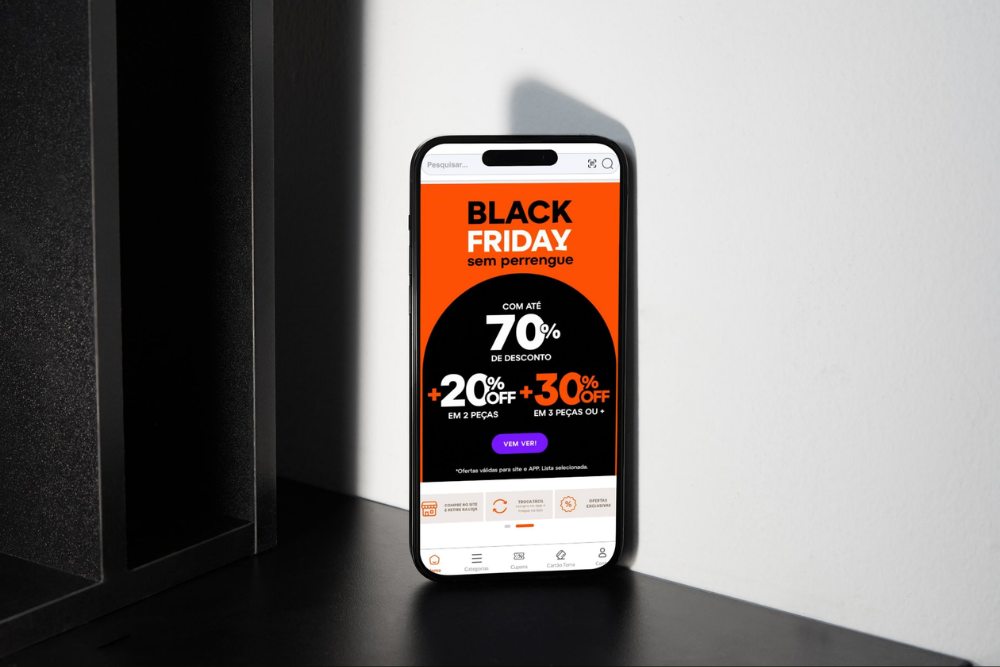
Brazilian consumers spent approximately 2,8 billion hours on shopping apps in a single year , according to data.ai's State of Mobile report . Brazil already holds the second position globally in download volume in this segment. However, many retail brands still base their mobile strategy solely on responsive websites, facing shopping cart abandonment rates as high as 85% on mobile devices.
The transition from a mobile website to a dedicated commerce app marks the difference between a user who merely browses and a customer who completes a purchase. The app reduces friction, retains payment data, and creates a direct communication channel via push notifications . A clear example of this level change is Lojas Torra, which restructured its mobile technology and recorded significant leaps in speed and sales.
On this page you will find:
The essentials about app commerce.
- What differentiates it from mobile web: While a responsive website runs in a mobile browser and requires loading with each click, an app is installed natively, ensuring smooth navigation and use of the device's own features, such as biometrics;
- Why is the conversion rate higher? Shopping apps convert, on average, three times more than mobile web. One-click checkout and the absence of distractions eliminate the final barriers to purchase.
- Impact on retention: The brand icon on the customer's home screen acts as a constant reminder. Push notifications have much higher open rates than email marketing.
- Deployment speed: Modern platforms operate on the SaaS model (Software as a Service), allowing retailers to launch robust applications integrated with their existing e-commerce platform in just a few weeks;
- Offer customization: The channel allows for the collection of precise browsing and geolocation data, enabling highly targeted campaigns and exclusive offers for those who have the app.
The browser's limitations and the need for a dedicated application.
Digital consumer behavior has solidified the smartphone as the primary device for product discovery. However, the mobile browsing experience presents natural challenges. Typing in 16 credit card numbers, filling out lengthy address forms, and dealing with slow page reloading on unstable 4G connections are factors that lead to abandoned purchases.
Investing in app commerce directly addresses these shortcomings. By keeping the user logged in and their payment details securely saved, the time between the purchase decision and order confirmation drops to seconds. This removal of obstacles explains the stark difference in conversion rates between the two channels.
Beyond usability, the app transforms the dynamics of customer acquisition. Instead of repeatedly paying for ads on Google or Meta to bring the same user back to the website, the retailer builds a proprietary database . Communication becomes direct and with zero marginal cost per impact.
The challenge for Lojas Torra: growth and performance.
Lojas Torra , a retail chain with a strong national presence, identified that it needed a mobile channel that could keep pace with the speed of its corporate growth. The brand's previous app did not deliver the performance required to support the volume of access and the expected user experience.
The central challenge was migrating to a technology that guaranteed stability during peak traffic, offered instant loading of dense catalogs, and, most importantly, delivered real and measurable financial results for the mobile channel. The brand needed an infrastructure that wouldn't limit the marketing team's actions and would support aggressive sales campaigns.
The solution: migrating to next-generation SaaS with Eitri.
To resolve this technological bottleneck, Lojas Torra opted to migrate to the Eitri platform. This choice represented the adoption of a new generation of SaaS technology specifically designed for app commerce.
Eitri stands out in the market for not using rigid templates or webviews (which only mirror the website within an app). The platform delivers native applications for iOS and Android, ensuring full use of the smartphone's processing power. Furthermore, the architecture features an integrated headless CMS, allowing Torra's marketing team to create storefronts, change banners, and launch campaigns in real time, without depending on updates in app stores (App Store and Google Play) or opening support tickets for the development team.
The seamless integration with the e-commerce ecosystem already used by the retailer allowed the transition to occur safely, unifying inventory, payment methods, and business rules into a single central intelligence.
Impressive results: speed and increased sales.
The adoption of native technology was immediately reflected in Lojas Torra 's business metrics . The gains in performance and usability altered the purchasing behavior of the installed customer base.
The data recorded after the migration proves the channel's impact:
- 3X faster speed: The new app is three times faster than the previous version, eliminating waiting time for image loading and screen transitions.
- +60% increase in conversion rate: The improved checkout process and frictionless navigation resulted in a 60% increase in mobile-specific conversion rates.
- +20% in sales share: The app's share of the company's total digital sales revenue grew by 20%, solidifying the channel as one of the brand's main sources of income.
The strategy for implementing app commerce in retail.
The results achieved by Lojas Torra illustrate the potential of a well-executed mobile channel. However, launching a successful app requires architectural planning. The app should not operate as an isolated silo, but rather as a natural extension of the existing e-commerce operation.
The ideal process for implementing a commerce app begins with complete integration with the store's existing e-commerce platform (such as VTEX, Shopify, or Wake). This ensures that the product catalog, price variations, shipping calculations, and customer data are always synchronized. The goal is for operational management to remain unified, while the end customer receives an interface optimized for touch and mobile screens.
e -Plus works on the architecture and implementation of these projects, combining its more than a decade of experience in digital retail with cutting-edge technologies such as Eitri 's . The focus is on delivering native, fast applications focused on generating conversions from day one of launch.
Having your own app is no longer a differentiator for large retail chains; it has become the most profitable channel for mature operations. If your brand needs to reduce shopping cart abandonment on mobile devices and build an engaged customer base, discover how our team can structure your project. Talk to the e-Plus experts about implementing an app commerce system and bring the native experience to your audience.
Frequently Asked Questions – App Commerce
What is the difference between a responsive website and a commerce app?
A responsive website adapts its layout to the mobile screen within the browser and requires a constant connection to load each page. A commerce app is software installed on the device that offers much faster browsing, native features (such as biometrics), and allows push notifications to be sent directly to the user.
How long does app commerce implementation take?
With the use of modern SaaS platforms focused on native applications, the time to launch has been drastically reduced. In structured operations with standardized integrations, it is possible to go live the application in about 30 to 45 days.
What metrics indicate the success of the mobile channel?
In addition to the number of downloads, it is essential to track monthly active users (MAU), the app's conversion rate (which should be higher than that of the mobile website), the average session time, the cost per install (CPI), and the app's share of total revenue.


